How to use this calculator
Predict the voltage jump and lost energy when two charged capacitors are connected in parallel.
- Enter Initially charged capacitance (F), Initial first voltage (V), Second capacitance (F), Initial second voltage (V). Match the units shown beside each field and review the result together with the assumptions below.
- Read the worked example below to check the expected input format and result.
- Compare another scenario by changing one input at a time. Use Reset to return to the starting values.
Capacitor charge sharing and energy loss explained
A numerical walkthrough
Initially charged capacitance (F) = 0.000001; Initial first voltage (V) = 5; Second capacitance (F) = 0.000002; Initial second voltage (V) = 1.
- Final shared voltage: 2.333333 V
- Energy dissipated: 0.000005 J
- Transferred charge: 0.000003 C
Connecting 1 microfarad at 5 V to 2 microfarads at 1 V settles to 7/3 V and dissipates 16/3 microjoules.
The model behind the numbers
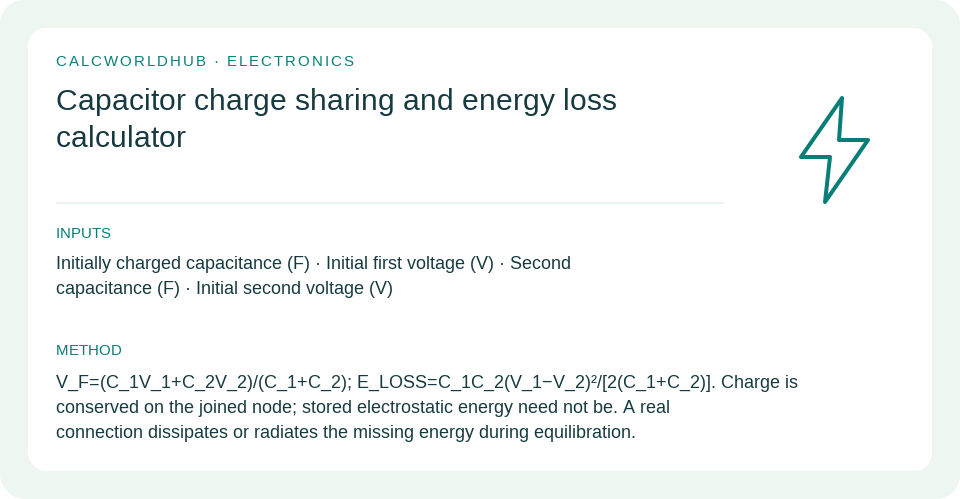
V_F=(C_1V_1+C_2V_2)/(C_1+C_2); E_LOSS=C_1C_2(V_1−V_2)²/[2(C_1+C_2)].
Charge is conserved on the joined node; stored electrostatic energy need not be. A real connection dissipates or radiates the missing energy during equilibration.
What to enter
C1— Initially charged capacitance (F)- First isolated capacitor before connecting equal-polarity nodes.
V1— Initial first voltage (V)- Signed initial voltage of first capacitor.
C2— Second capacitance (F)- Second isolated capacitance sharing the same return.
V2— Initial second voltage (V)- Signed initial voltage of second capacitor.
Interpreting the result
Linear capacitors sharing a common reference, no external supply, final equilibrium only. Peak switch current requires parasitic resistance and inductance.
Reading the outputs
Transferred charge is positive when it leaves capacitor 1. The loss is nonnegative even for opposite initial polarities.
Frequently asked questions
Where does the missing energy go?
Into resistance, electromagnetic radiation and other nonideal paths during the transient.
Can one voltage be negative?
Yes, provided both signed voltages use the same reference and connection polarity.
Will zero connection resistance remove the loss?
No; an idealized instantaneous connection is singular, and physical parasitics govern the transient.
How do I use the Capacitor charge sharing and energy loss calculator?
Enter Initially charged capacitance (F), Initial first voltage (V), Second capacitance (F), Initial second voltage (V). Match the units shown beside each field and review the result together with the assumptions below.
What is a worked example of Capacitor charge sharing and energy loss?
Initially charged capacitance (F) = 0.000001; Initial first voltage (V) = 5; Second capacitance (F) = 0.000002; Initial second voltage (V) = 1. Final shared voltage: 2.333333 V Energy dissipated: 0.000005 J Transferred charge: 0.000003 C Connecting 1 microfarad at 5 V to 2 microfarads at 1 V settles to 7/3 V and dissipates 16/3 microjoules.
Read our calculation methodology.