CAPM expected return calculator
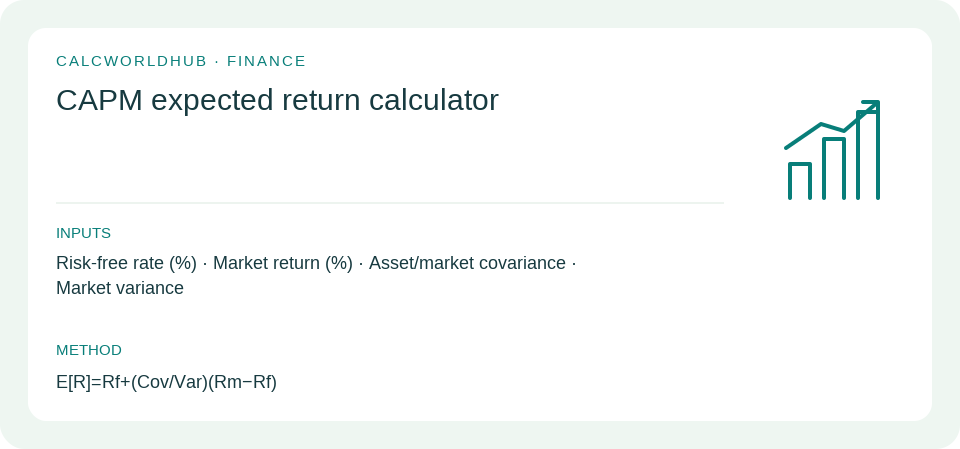
Estimate required return using the CAPM risk-free rate, market premium, and covariance-based beta.
Calculator
How to use this calculator
Estimate required return using the CAPM risk-free rate, market premium, and covariance-based beta.
- Enter Risk-free rate (%), Market return (%), Asset/market covariance, Market variance. Match the units shown beside each field and review the result together with the assumptions below.
- Read the worked example below to check the expected input format and result.
- Compare another scenario by changing one input at a time. Use Reset to return to the starting values.
CAPM expected return calculator
Estimate required return using the CAPM risk-free rate, market premium, and covariance-based beta.
Inputs and units
- Risk-free rate (%): Risk-free return for the same investment horizon and percentage convention as market return.
- Market return (%): Expected market-portfolio return for the same horizon as the risk-free rate.
- Asset/market covariance: Covariance of asset and market returns using a consistent return scale and observation period.
- Market variance: Variance of market returns; must be positive and use the same return scale as covariance.
Formula and method
E[R]=Rf+(Cov/Var)(Rm−Rf)
Worked example
Rf=3%, Rm=8%, covariance=0.018 and market variance=0.012 imply β=1.5 and E[R]=3%+1.5(5%)=10.5%.
Interpreting the result
The market premium is Rm−Rf; beta scales that premium. A negative beta can mathematically lower the estimate below the risk-free rate.
Assumptions and limits
Market variance must be positive; rates must share a period and percentage convention. CAPM is a model with assumptions, not a promised return.
Sources and method
- States expected return as risk-free rate plus beta times the market risk premium. OpenStax Principles of Finance: the capital asset pricing model
Frequently asked questions
Which inputs determine this result?
The visible inputs are Risk-free rate (%), Market return (%), Asset/market covariance, Market variance. Each is used by the displayed formula; the calculator does not use any other hidden measurement.
When does this method apply?
Market variance must be positive; rates must share a period and percentage convention. CAPM is a model with assumptions, not a promised return.
How do I use the CAPM expected return calculator?
Enter Risk-free rate (%), Market return (%), Asset/market covariance, Market variance. Match the units shown beside each field and review the result together with the assumptions below.
What is a worked example of CAPM expected return?
Rf=3%, Rm=8%, covariance=0.018 and market variance=0.012 imply β=1.5 and E[R]=3%+1.5(5%)=10.5%.
What does the CAPM expected return calculator calculate?
Estimate required return using the CAPM risk-free rate, market premium, and covariance-based beta.
See the calculation methodology.
Good calculators show their work.
CalcWorldHub is built around clear inputs and visible assumptions. Results are estimates for planning; check official sources or your provider’s terms when exact figures matter.