How to use this calculator
Project end-of-lease mileage and estimate a contract-based excess-mileage charge from your current driving pace.
- Enter Total contracted mileage allowance (miles), Miles driven since lease start, Months elapsed, Full lease term (months), then complete the remaining labeled fields. Match the units shown beside each field and review the result together with the assumptions below.
- Read the worked example below to check the expected input format and result.
- Compare another scenario by changing one input at a time. Use Reset to return to the starting values.
How this calculation works
An annual or total mileage allowance is set by the lease contract, but a driver can compare current use with that cap before the vehicle is returned. This estimator calculates an average monthly pace from miles driven so far, extends that pace across the full term, and applies the contract’s per-mile fee only to projected miles above the allowance.
Inputs and units
allowanceMiles— Total contracted mileage allowance (miles)- Enter the full-term mileage cap from the lease agreement.
milesUsed— Miles driven since lease start- Use odometer miles traveled under this lease so far.
monthsElapsed— Months elapsed- Enter months since the lease began; must be greater than zero.
termMonths— Full lease term (months)- Enter the complete contract duration and ensure it is not shorter than elapsed months.
feePerMile— Excess-mile fee ($/mile)- Use the charge stated in the contract, not an average market estimate.
Formula
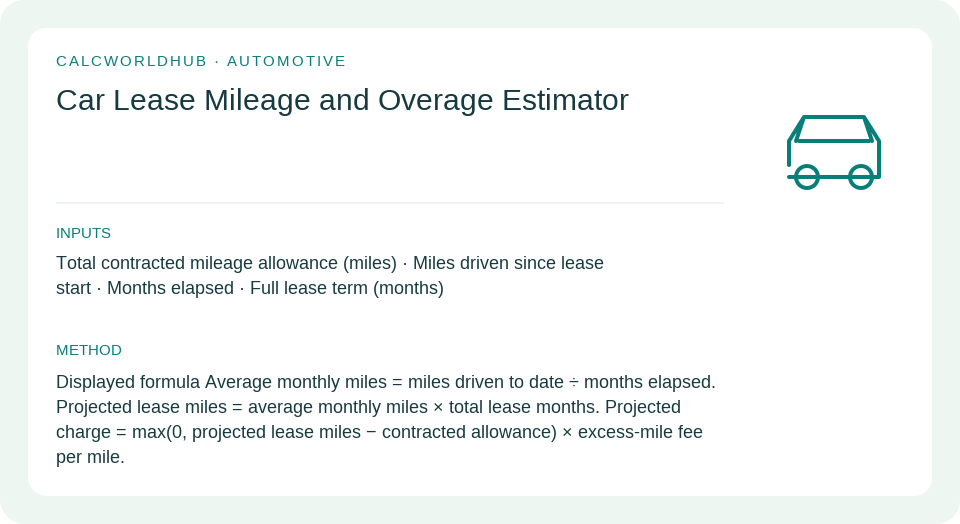
Average monthly miles = miles driven to date ÷ months elapsed. Projected lease miles = average monthly miles × total lease months. Projected charge = max(0, projected lease miles − contracted allowance) × excess-mile fee per mile.
Method
Use the total mileage allowance for the whole contract, not an annual limit unless you multiply it by the term in years. Enter actual miles since lease start, elapsed months, full term in months, and the exact excess-mile rate written in the agreement.
Worked example
After 18 months, 18,000 miles implies a pace of 1,000 miles per month. If that pace continues through a 36-month lease, projected mileage is 36,000. Against a 30,000-mile allowance and a $0.25 fee, the estimated overage charge is (36,000 − 30,000) × $0.25 = $1,500.
Assumptions and limits
This is a straight-line projection from the observed average pace, not an invoice or guarantee. Driving patterns may change; prorated allowances, grace policies, fees, taxes, and contract-specific calculations can differ. Review the signed lease and contact the lessor for the official payoff or return quote.
Frequently asked questions
Should I enter an annual or full-term mileage cap?
Enter the total allowance for the whole lease. Multiply an annual allowance by the lease years before entering it.
Does the estimated fee match the final bill?
Not necessarily. It projects a fee using your current average pace and the rate you enter; the contract and lessor’s final odometer reading control.
Can I reduce projected overage by driving less later?
Yes. A lower future mileage pace would change the projection; recalculate with a realistic average or your own expected end mileage.
Does this include wear-and-tear charges?
No. It estimates excess mileage only and does not price vehicle condition, disposition, taxes, or other return fees.
How do I use the Car Lease Mileage and Overage Estimator?
Enter Total contracted mileage allowance (miles), Miles driven since lease start, Months elapsed, Full lease term (months), then complete the remaining labeled fields. Match the units shown beside each field and review the result together with the assumptions below.
Reference: CFPB guidance on lease mileage limits and possible excess-mileage charges. See our calculation methodology.