How to use this calculator
Estimate species richness from replicated sampling units using the bias-corrected incidence-based Chao2 estimator.
- Enter Comparable sampling units, m, Observed species richness, Sobs, Species detected in exactly one unit, Q₁, Species detected in exactly two units, Q₂. Match the units shown beside each field and review the result together with the assumptions below.
- Read the worked example below to check the expected input format and result.
- Compare another scenario by changing one input at a time. Use Reset to return to the starting values.
How this calculation works
Enter the number of comparable sampling units, the number of observed species, and how many species occur in exactly one or exactly two units. Chao2 uses the rare-incidence counts to estimate the species richness that the repeated sampling may have missed.
Inputs and units
sampleUnits— Comparable sampling units, m- Number of replicated sites, plots, visits, reaches, or other sampling units represented in the incidence summary.
observedSpecies— Observed species richness, Sobs- Number of distinct species detected in at least one sampling unit.
uniqueSpecies— Species detected in exactly one unit, Q₁- Count of species recorded in one and only one of the sampling units.
doubletonSpecies— Species detected in exactly two units, Q₂- Count of species recorded in exactly two sampling units.
Formula
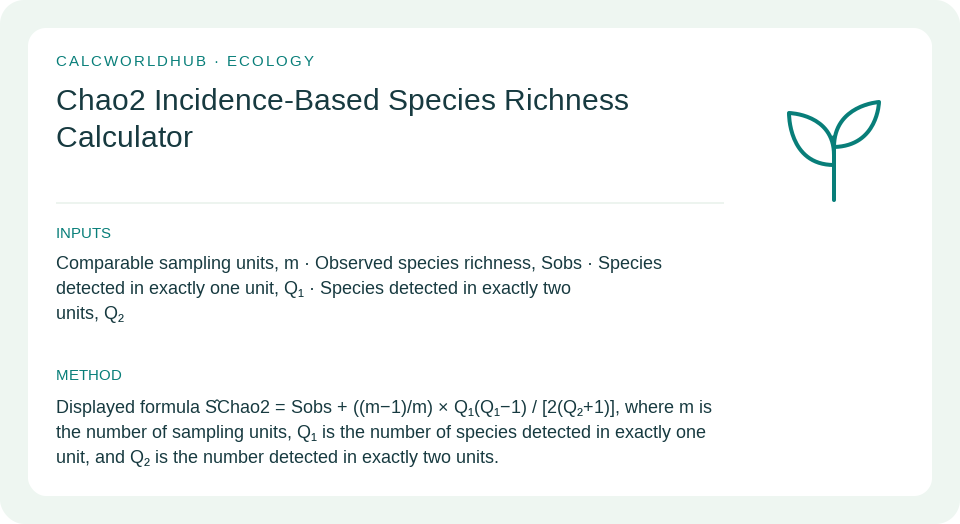
ŜChao2 = Sobs + ((m−1)/m) × Q₁(Q₁−1) / [2(Q₂+1)], where m is the number of sampling units, Q₁ is the number of species detected in exactly one unit, and Q₂ is the number detected in exactly two units.
Method
Start with the observed species count Sobs, then add the bias-corrected Chao2 estimate of unseen richness from the frequencies of species detected in exactly one or two sampling units. The result can be non-integer because it is an estimator.
Worked example
Across 10 comparable sampling units, 30 species were observed; 8 occurred in exactly one unit and 4 in exactly two units. The bias-corrected Chao2 estimate is 35.04 species, an estimated increment of 5.04 beyond the observed 30.
Assumptions and limits
Use presence/absence incidence across at least two comparable replicated sampling units, not individual abundance counts from one sample. The bias-corrected Chao2 value is a nonparametric lower-bound style richness estimator, not a guarantee of the true species pool or a confidence interval. Unequal effort and strongly varying detectability can affect interpretation.
Frequently asked questions
What is an incidence-based estimate?
It uses how many repeated sampling units contain each species, rather than the number of individual organisms counted in a single abundance sample.
What are uniques and duplicates?
Q₁ counts species detected in exactly one sampling unit. Q₂ counts species detected in exactly two units.
Does Chao2 give the guaranteed total number of species?
No. It is an estimator based on observed incidence frequencies. It can indicate unseen richness, but it does not guarantee the species pool or replace a study-specific uncertainty analysis.
How do I use the Chao2 Incidence-Based Species Richness Calculator?
Enter Comparable sampling units, m, Observed species richness, Sobs, Species detected in exactly one unit, Q₁, Species detected in exactly two units, Q₂. Match the units shown beside each field and review the result together with the assumptions below.
What is a worked example of Chao2 Incidence-Based Species Richness?
Across 10 comparable sampling units, 30 species were observed; 8 occurred in exactly one unit and 4 in exactly two units. The bias-corrected Chao2 estimate is 35.04 species, an estimated increment of 5.04 beyond the observed 30.
Reference: National Athletic Trainers’ Association fluid-replacement position statement. See our calculation methodology.