How to use this calculator
Estimate average charge-carrier drift velocity from current, carrier density, and cross-sectional area.
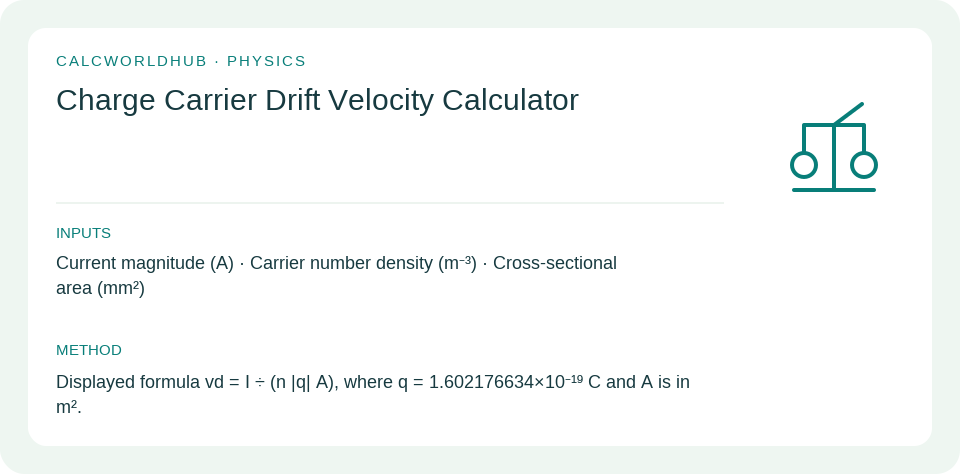
- Enter Current magnitude (A), Carrier number density (m⁻³), Cross-sectional area (mm²). Match the units shown beside each field and review the result together with the assumptions below.
- Read the worked example below to check the expected input format and result.
- Compare another scenario by changing one input at a time. Use Reset to return to the starting values.
How this calculation works
Current through a uniform cross-section is the carrier charge multiplied by the number density, cross-sectional area, and average drift speed. Solving that relation for speed gives a microscopic average velocity distinct from the much faster random thermal motion of carriers.
Inputs and units
currentA— Current magnitude (A)- Magnitude of current through the sample in amperes.
carrierDensity— Carrier number density (m⁻³)- Mobile charge-carrier count per cubic meter.
areaMm2— Cross-sectional area (mm²)- Uniform area perpendicular to current flow in square millimeters.
Formula
vd = I ÷ (n |q| A), where q = 1.602176634×10⁻¹⁹ C and A is in m².
Method
Enter current magnitude in amperes, carrier number density in m⁻³, and cross-sectional area in mm². The calculator converts area to m² and returns drift-speed magnitude and current density.
Worked example
For 1 A through a 1 mm² cross-section with carrier density 8.5×10²⁸ m⁻³, the estimated drift-speed magnitude is about 0.00007343 m/s.
Assumptions and limits
This is a uniform-current, single-carrier-density model. It estimates the average drift speed, not the much larger microscopic thermal speed or carrier motion direction. Real materials can have multiple carriers, nonuniform current density, and spatially varying carrier concentrations.
Frequently asked questions
What is drift velocity?
It is the average velocity component associated with net charge transport through a material.
Is drift speed the same as electron thermal speed?
No. Thermal motion is much faster and largely random; drift velocity is the small average associated with current.
Does carrier sign affect this result?
The calculator reports magnitude. Electrons and positive carriers move in opposite directions relative to conventional current.
How do I use the Charge Carrier Drift Velocity Calculator?
Enter Current magnitude (A), Carrier number density (m⁻³), Cross-sectional area (mm²). Match the units shown beside each field and review the result together with the assumptions below.
What is a worked example of Charge Carrier Drift Velocity?
For 1 A through a 1 mm² cross-section with carrier density 8.5×10²⁸ m⁻³, the estimated drift-speed magnitude is about 0.00007343 m/s.
Reference: OpenStax University Physics derivation of current, carrier density, area, and drift velocity. See our calculation methodology.