How to use this calculator
Convert a reaction-specific molarity into equivalent concentration and total equivalents.
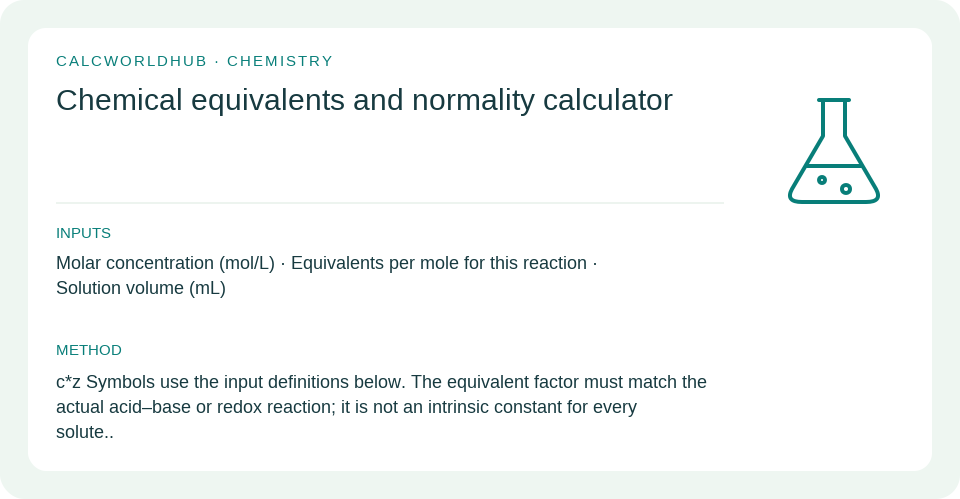
- Enter Molar concentration (mol/L), Equivalents per mole for this reaction, Solution volume (mL). Match the units shown beside each field and review the result together with the assumptions below.
- Read the worked example below to check the expected input format and result.
- Compare another scenario by changing one input at a time. Use Reset to return to the starting values.
Chemical equivalents and normality explained
Normality is reaction-specific: multiply molar concentration by the number of equivalents per mole for the reaction being analyzed. The corresponding total equivalents also depend on solution volume, so the chosen equivalence factor and volume basis must match the actual titration or reaction.
Inputs, symbols, and units
c— Molar concentration (mol/L)- Molar concentration (mol/L).
z— Equivalents per mole for this reaction- Equivalents per mole for this reaction.
vol— Solution volume (mL)- Solution volume (mL).
Formula and method
c*z
Symbols use the input definitions below. The equivalent factor must match the actual acid–base or redox reaction; it is not an intrinsic constant for every solute..
A worked scenario
Molar concentration (mol/L) = 0.2; Equivalents per mole for this reaction = 2; Solution volume (mL) = 250.
- Normality: 0.4 eq/L
- Total equivalents: 0.1 eq
This scenario uses the stated units and assumptions. Displayed values are rounded only after calculation.
Assumptions and edge cases
The equivalent factor must match the actual acid–base or redox reaction; it is not an intrinsic constant for every solute.
Frequently asked questions
Can the same acid have different normalities?
Yes, depending on how many protons participate.
Is normality the same as molarity?
Only when the equivalent factor is one.
Why enter volume?
It gives the total reaction equivalents in the aliquot.
How do I use the Chemical equivalents and normality calculator?
Enter Molar concentration (mol/L), Equivalents per mole for this reaction, Solution volume (mL). Match the units shown beside each field and review the result together with the assumptions below.
What is a worked example of Chemical equivalents and normality?
Molar concentration (mol/L) = 0.2; Equivalents per mole for this reaction = 2; Solution volume (mL) = 250. Normality: 0.4 eq/L Total equivalents: 0.1 eq This scenario uses the stated units and assumptions. Displayed values are rounded only after calculation.
Read our calculation methodology.