Chi-square cell contribution calculator
Measure one observed cell’s contribution to Pearson’s chi-square statistic. Enter the values below to see the result and method.
inputs.
Related calculators
Use these tools when your question extends to a neighboring part of the same calculation.
How to use this calculator
Calculate one chi-square cell contribution from observed and expected counts, with a formula, worked example, and explanation of its role in a full statistic.
- Enter Observed count, Expected count. Match the units shown beside each field and review the result together with the assumptions below.
- Compare the worked example with your inputs and result.
- Compare another scenario by changing one input at a time. Use Reset to return to the starting values.
Measure one cell’s contribution to a chi-square statistic
A cell contributes the squared observed-minus-expected difference divided by its expected count. A whole table’s statistic is the sum of these cell contributions.
Inputs and units
- Observed count
- Expected count
Formula and method
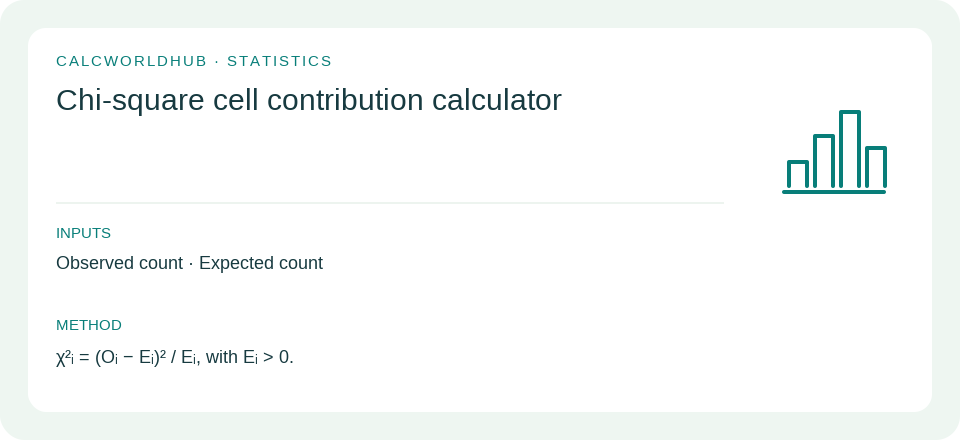
χ²ᵢ = (Oᵢ − Eᵢ)² / Eᵢ, with Eᵢ > 0.
Worked example
For O=14 and E=12, (14−12)²/12 = 4/12 = 0.3333.
Interpreting the result
A larger value means this cell contributes more to the table statistic; it is not a stand-alone p-value.
Assumptions and limits
Use an expected count computed under the test’s null model. Sparse expected counts can affect the validity of a chi-square approximation.
Method references
Frequently asked questions
Is 0.3333 the test statistic for the whole table?
Only if this is the table’s sole cell; otherwise add all cell contributions.
How do I use the Chi-square cell contribution calculator?
Enter Observed count, Expected count. Match the units shown beside each field and review the result together with the assumptions below.
What is a worked example of Chi-square cell contribution?
For O=14 and E=12, (14−12)²/12 = 4/12 = 0.3333.
What does the Chi-square cell contribution calculator calculate?
Calculate one chi-square cell contribution from observed and expected counts, with a formula, worked example, and explanation of its role in a full statistic.
What assumptions apply to Chi-square cell contribution?
Use an expected count computed under the test’s null model. Sparse expected counts can affect the validity of a chi-square approximation.