How to use this calculator
Estimate ideal-gas throat flow only when the entered pressure ratio supports choking.
- Enter Throat area (mm²), Discharge coefficient, Upstream stagnation pressure (kPa abs), Back pressure (kPa abs), then complete the remaining labeled fields. Match the units shown beside each field and review the result together with the assumptions below.
- Read the worked example below to check the expected input format and result.
- Compare another scenario by changing one input at a time. Use Reset to return to the starting values.
Choked ideal gas mass flow explained
The entered absolute pressures place this ideal nozzle below its critical back-pressure ratio.
A numerical walkthrough
Throat area (mm²) = 10; Discharge coefficient = 0.8; Upstream stagnation pressure (kPa abs) = 500; Back pressure (kPa abs) = 100; Stagnation temperature (K) = 300; Heat-capacity ratio = 1.4; Specific gas constant (J/kg·K) = 287.
- Choked mass flow: 0.00933423 kg/s
Here the back-pressure ratio is 100/500 = 0.20, below the ideal critical ratio of about 0.528 for γ = 1.4. The choked model therefore gives 0.00933 kg/s before any real-gas or heat-transfer corrections.
The model behind the numbers
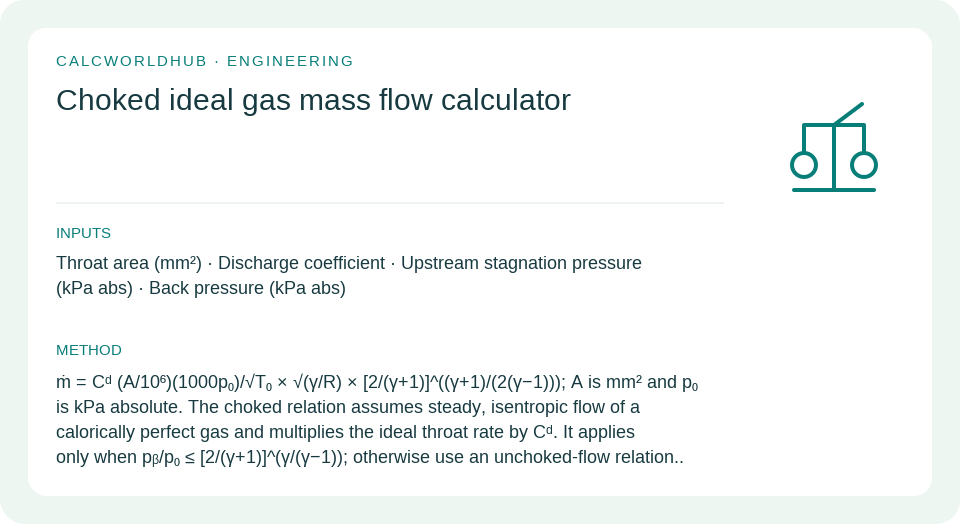
ṁ = Cᵈ (A/10⁶)(1000p₀)/√T₀ × √(γ/R) × [2/(γ+1)]^((γ+1)/(2(γ−1))); A is mm² and p₀ is kPa absolute.
The choked relation assumes steady, isentropic flow of a calorically perfect gas and multiplies the ideal throat rate by Cᵈ. It applies only when pᵦ/p₀ ≤ [2/(γ+1)]^(γ/(γ−1)); otherwise use an unchoked-flow relation..
What to enter
a— Throat area (mm²)- Minimum flow area at the nozzle throat; converted from mm² to m² inside the mass-flow equation.
c— Discharge coefficient- Dimensionless multiplier for non-ideal contraction and losses; use a value appropriate to the nozzle.
p— Upstream stagnation pressure (kPa abs)- Absolute upstream total pressure p₀, not gauge pressure; converted to pascals in the equation.
b— Back pressure (kPa abs)- Absolute downstream pressure. Choking requires pᵦ/p₀ at or below the critical ratio for γ.
t— Stagnation temperature (K)- Absolute upstream total temperature T₀ in kelvins.
g— Heat-capacity ratio- Specific-heat ratio γ = cₚ/cᵥ for the assumed calorically perfect gas.
r— Specific gas constant (J/kg·K)- Gas-specific R in J/(kg·K); choose it for the gas being modeled.
Interpreting the result
This result is valid only when the entered back-pressure ratio meets the choked-flow condition; it does not estimate unchoked flow.
Verified reference: NASA Glenn, Mass Flow Rate Equations.
Frequently asked questions
Why reject high back pressure?
The stated choked relation would not apply.
Is upstream pressure absolute?
Yes.
Does it model real-gas behavior?
No.
How do I use the Choked ideal gas mass flow calculator?
Enter Throat area (mm²), Discharge coefficient, Upstream stagnation pressure (kPa abs), Back pressure (kPa abs), then complete the remaining labeled fields. Match the units shown beside each field and review the result together with the assumptions below.
What is a worked example of Choked ideal gas mass flow?
Throat area (mm²) = 10; Discharge coefficient = 0.8; Upstream stagnation pressure (kPa abs) = 500; Back pressure (kPa abs) = 100; Stagnation temperature (K) = 300; Heat-capacity ratio = 1.4; Specific gas constant (J/kg·K) = 287. Choked mass flow: 0.00933423 kg/s Here the back-pressure ratio is 100/500 = 0.20, below the ideal critical ratio of about 0.528 for γ = 1.4. The choked model therefore gives 0.00933 kg/s before any real-gas or heat-transfer corrections.
Method reference: NASA compressible mass flow.
Read our calculation methodology.