How to use this calculator
Inspect the gain growth and low-frequency droop of a cascaded-integrator-comb decimation filter.
- Enter Decimation factor, Differential delay, Integrator comb stages, Sampling frequency (Hz), then complete the remaining labeled fields. Match the units shown beside each field and review the result together with the assumptions below.
- Read the worked example below to check the expected input format and result.
- Compare another scenario by changing one input at a time. Use Reset to return to the starting values.
CIC decimator gain and passband droop explained
A CIC decimator reduces sample rate by R, while stage count N and delay M set its gain and frequency-dependent passband droop.
A numerical walkthrough
Decimation factor = 8; Differential delay = 1; Integrator comb stages = 3; Sampling frequency (Hz) = 48000; Passband evaluation frequency (Hz) = 1000.
- Normalized passband magnitude: 0.872659 ratio
- Unnormalized DC gain: 512 ratio
- Output sample rate: 6000 Hz
A three-stage decimator reduces 48 kHz by eight; evaluate attenuation of a one-kilohertz component.
The model behind the numbers
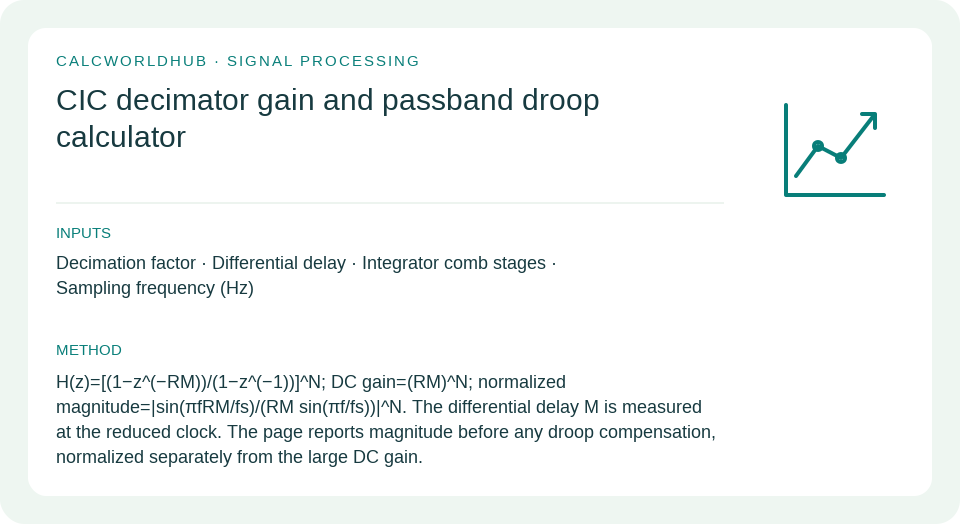
H(z)=[(1−z^(−RM))/(1−z^(−1))]^N; DC gain=(RM)^N; normalized magnitude=|sin(πfRM/fs)/(RM sin(πf/fs))|^N.
The differential delay M is measured at the reduced clock. The page reports magnitude before any droop compensation, normalized separately from the large DC gain.
What to enter
R— Decimation factor- Positive integer rate reduction. Enter a whole number.
M— Differential delay- Comb delay at the reduced sample clock. Enter a whole number.
stages— Integrator comb stages- Number of repeated integrator/comb pairs. Enter a whole number.
fs— Sampling frequency (Hz)- Uniform samples per second; must be positive.
f— Passband evaluation frequency (Hz)- Nonnegative frequency no higher than the output Nyquist limit.
Interpreting the result
Ideal arithmetic only. No word-length pruning, overflow, alias-image rejection budget or compensation FIR is designed.
Reading the outputs
Normalized magnitude excludes DC gain; output rate identifies the reduced clock.
Frequently asked questions
Why is the unnormalized gain large?
Each moving-sum equivalent contributes RM, repeated for every stage.
Does unity DC normalization remove droop?
No. It only rescales the entire response.
What is special about frequency zero?
The sine ratio is evaluated by its limit of one.
How do I use the CIC decimator gain and passband droop calculator?
Enter Decimation factor, Differential delay, Integrator comb stages, Sampling frequency (Hz), then complete the remaining labeled fields. Match the units shown beside each field and review the result together with the assumptions below.
What is a worked example of CIC decimator gain and passband droop?
Decimation factor = 8; Differential delay = 1; Integrator comb stages = 3; Sampling frequency (Hz) = 48000; Passband evaluation frequency (Hz) = 1000. Normalized passband magnitude: 0.872659 ratio Unnormalized DC gain: 512 ratio Output sample rate: 6000 Hz A three-stage decimator reduces 48 kHz by eight; evaluate attenuation of a one-kilohertz component.
Read our calculation methodology.