How to use this calculator
Quantify how far angular observations depart from circular uniformity using the rotation-invariant Kuiper distance.
- Enter Angles in degrees. Match the units shown beside each field and review the result together with the assumptions below.
- Read the worked example below to check the expected input format and result.
- Compare another scenario by changing one input at a time. Use Reset to return to the starting values.
Circular Kuiper uniformity distance explained
This guide follows circular kuiper uniformity distance calculator from its stated formula through a worked example, then identifies the assumptions that bound the result.
A numerical walkthrough
Angles in degrees = 5,20,45,90,140,185,250,310.
- Circular Kuiper distance V: 0.26388889
- D plus: 0.25
- D minus: 0.01388889
The eight directions span most of the circle but leave uneven gaps. Rotating every direction by the same angle should preserve the Kuiper distance, up to numerical rounding.
The model behind the numbers
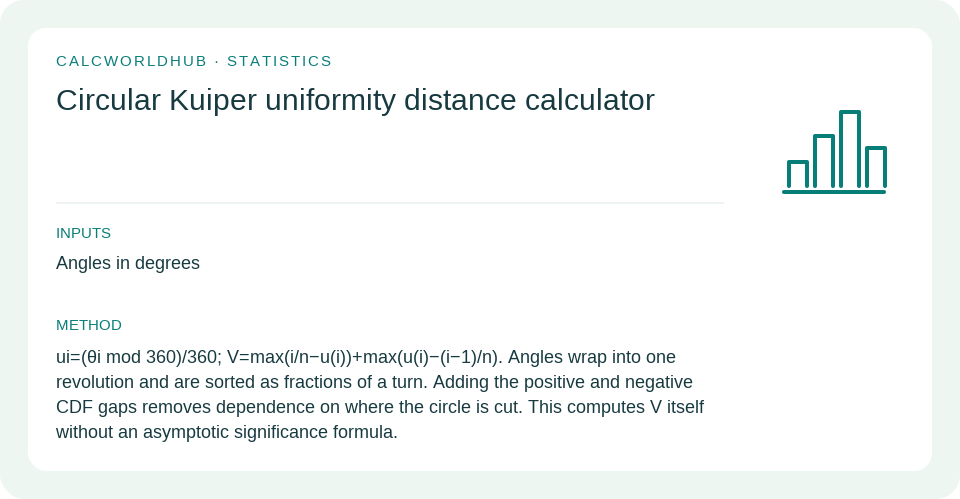
ui=(θi mod 360)/360; V=max(i/n−u(i))+max(u(i)−(i−1)/n).
Angles wrap into one revolution and are sorted as fractions of a turn. Adding the positive and negative CDF gaps removes dependence on where the circle is cut. This computes V itself without an asymptotic significance formula.
What to enter
x— Angles in degrees- Angular observations in degrees. Negative angles and values over 360 are wrapped into one revolution. Use comma-separated values in the stated order.
Interpreting the result
2–2,000 independent angles. No p-value is supplied. A concentrated angular distribution is not the only possible departure from uniformity; multimodal patterns can also increase V.
Reading the outputs
V is dimensionless and combines the two directional gaps. It is a circular distribution discrepancy, whereas a mean direction measures a different property.
Frequently asked questions
Can I enter negative angles?
Yes. Values wrap into 0–360 degrees.
Why not use ordinary KS for compass directions?
Its maximum gap can depend on the chosen zero direction; Kuiper adds both directional gaps.
Does V alone give a significance threshold?
No. Thresholds depend on sample size and the chosen reference calibration.
How do I use the Circular Kuiper uniformity distance calculator?
Enter Angles in degrees. Match the units shown beside each field and review the result together with the assumptions below.
What is a worked example of Circular Kuiper uniformity distance?
Angles in degrees = 5,20,45,90,140,185,250,310. Circular Kuiper distance V: 0.26388889 D plus: 0.25 D minus: 0.01388889 The eight directions span most of the circle but leave uneven gaps. Rotating every direction by the same angle should preserve the Kuiper distance, up to numerical rounding.
Method reference: Astropy Kuiper statistic definition.
Read our calculation methodology.