Circular pipe flow rate calculator
Calculate the volume flow crossing a pipe section each second.
inputs.
Calculator
How to use this calculator
Calculate circular-pipe volumetric flow from cross-sectional area and mean fluid speed.
- Enter Flow cross-sectional area A (m²), Mean flow speed v (m/s). Match the units shown beside each field and review the result together with the assumptions below.
- Read the worked example below to check the expected input format and result.
- Compare another scenario by changing one input at a time. Use Reset to return to the starting values.
Convert pipe area and mean speed into volume flow
This calculator finds volumetric flow from a flow cross-section and the average speed through it. It reports how much volume crosses that section per second.
Inputs and units
- Flow cross-sectional area A (m²): Open area perpendicular to the flow, in square meters.
- Mean flow speed v (m/s): Average velocity normal to that same cross-section, in meters per second.
Formula and method
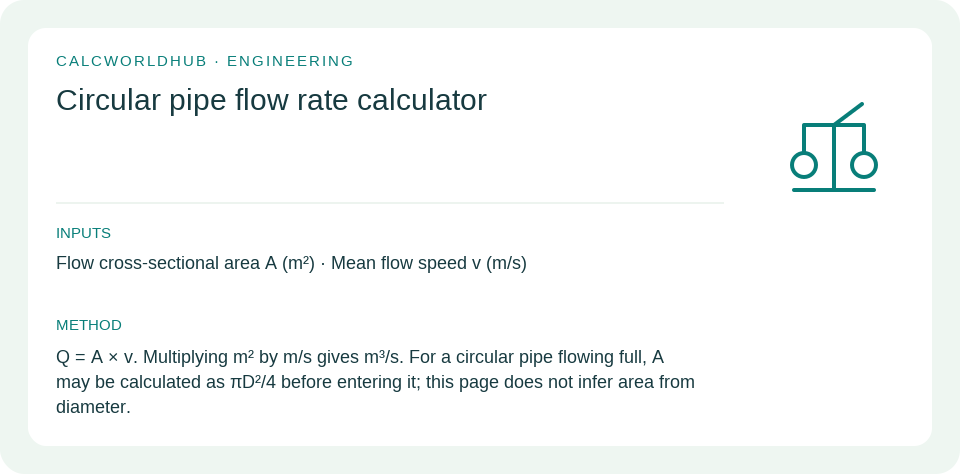
Q = A × v. Multiplying m² by m/s gives m³/s. For a circular pipe flowing full, A may be calculated as πD²/4 before entering it; this page does not infer area from diameter.
Worked example
With A = 0.002 m² and mean speed v = 1.2 m/s, Q = 0.002 × 1.2 = 0.0024 m³/s, or 2.4 L/s.
Interpreting the result
The section carries 0.0024 cubic meters each second under the stated average speed. The result is a volume rate; mass flow would also require fluid density.
Assumptions and limits
Use the average velocity over the same open cross-section. This relation does not calculate pressure loss, Reynolds number, or a velocity profile, and it does not account for a partially filled pipe.
Method references
Frequently asked questions
Why are density and viscosity not required?
Volumetric flow is area times mean velocity. Density is needed for mass flow, while viscosity can matter in a separate friction or Reynolds-number analysis.
How do I use the Circular pipe flow rate calculator?
Enter Flow cross-sectional area A (m²), Mean flow speed v (m/s). Match the units shown beside each field and review the result together with the assumptions below.
What is a worked example of Circular pipe flow rate?
With A = 0.002 m² and mean speed v = 1.2 m/s, Q = 0.002 × 1.2 = 0.0024 m³/s, or 2.4 L/s.
What does the Circular pipe flow rate calculator calculate?
Calculate circular-pipe volumetric flow from cross-sectional area and mean fluid speed.
What assumptions apply to Circular pipe flow rate?
Use the average velocity over the same open cross-section. This relation does not calculate pressure loss, Reynolds number, or a velocity profile, and it does not account for a partially filled pipe.
Good calculators show their work.
CalcWorldHub is built around clear inputs and visible assumptions. Results are estimates for planning; check official sources or your provider’s terms when exact figures matter.