How to use this calculator
Compare the largest and smallest class counts in a two-class dataset before model evaluation.
- Enter Class A examples, Class B examples. Match the units shown beside each field and review the result together with the assumptions below.
- Read the worked example below to check the expected input format and result.
- Compare another scenario by changing one input at a time. Use Reset to return to the starting values.
How this calculation works
The imbalance ratio describes how many observations belong to the majority class for each observation in the minority class. The minority share adds context by showing its fraction of all labeled rows; neither statistic alone determines model quality.
Inputs and units
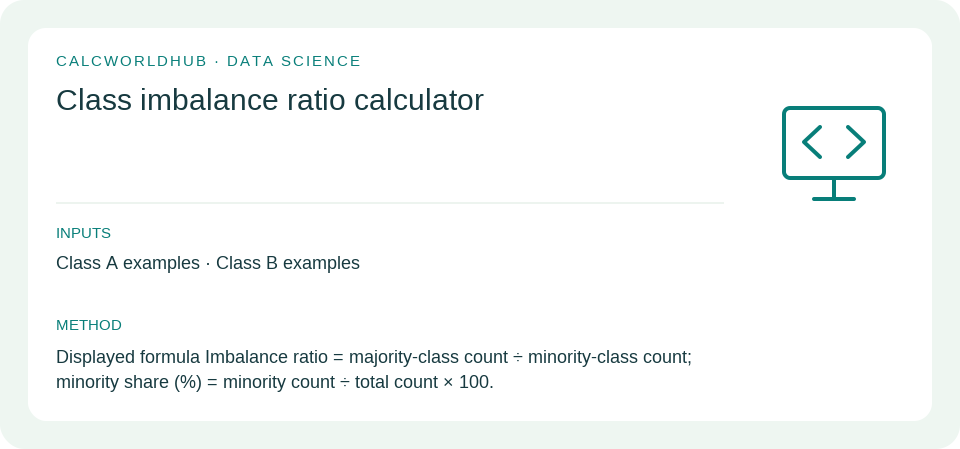
classA— Class A examples- Enter the number of labeled observations in the first class.
classB— Class B examples- Enter the number of labeled observations in the second class.
Formula
Imbalance ratio = majority-class count ÷ minority-class count; minority share (%) = minority count ÷ total count × 100.
Method
Enter the labeled example counts for two classes. The calculator identifies the larger and smaller counts, then reports their ratio and the smaller class's share of the combined dataset.
Worked example
For 900 examples in one class and 100 in the other, the ratio is 900 ÷ 100 = 9:1 and the minority share is 100 ÷ 1,000 × 100 = 10%.
Assumptions and limits
This is a count summary for two classes only. It does not choose a resampling method, account for class costs, estimate generalization performance, or replace validation on representative data.
Frequently asked questions
What does a 9:1 imbalance ratio mean?
The majority class has nine times as many examples as the minority class in the entered two-class dataset.
Does a larger imbalance ratio prove a model is biased?
No. It describes class counts, not prediction behavior. Evaluate per-class metrics and use a validation set that reflects the intended population.
Can this calculate imbalance for more than two classes?
This calculator compares two classes. For multiple classes, compare each class count with the largest count or use a multiclass summary.
How do I use the Class imbalance ratio calculator?
Enter Class A examples, Class B examples. Match the units shown beside each field and review the result together with the assumptions below.
What is a worked example of Class imbalance ratio?
For 900 examples in one class and 100 in the other, the ratio is 900 ÷ 100 = 9:1 and the minority share is 100 ÷ 1,000 × 100 = 10%.
Read our calculation methodology.