How to use this calculator
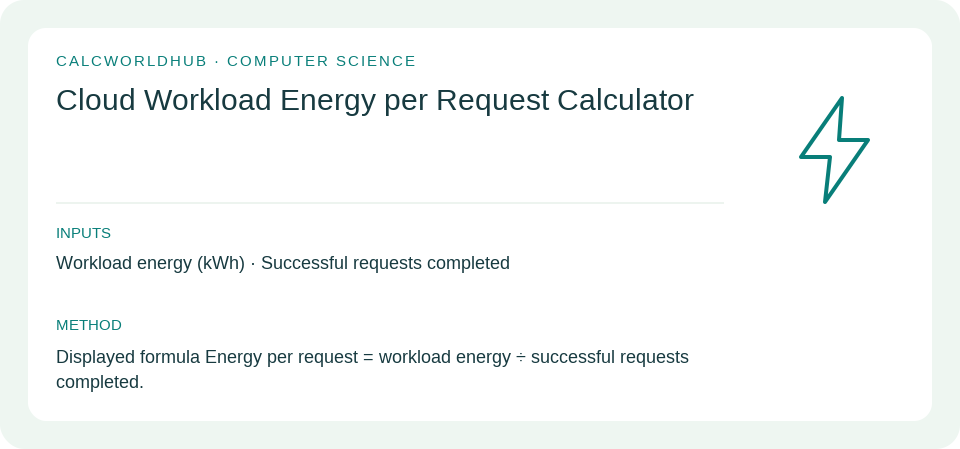
Normalize measured workload energy by completed successful requests.
- Enter Workload energy (kWh), Successful requests completed. Match the units shown beside each field and review the result together with the assumptions below.
- Read the worked example below to check the expected input format and result.
- Compare another scenario by changing one input at a time. Use Reset to return to the starting values.
How this calculation works
Energy per request can help compare the operational energy of the same service or workload across releases and infrastructure changes. Use energy and completed-request counts from the same measurement interval.
Inputs and units
workloadEnergyKwh— Workload energy (kWh)- Measured or consistently allocated energy for the workload.
successfulRequests— Successful requests completed- Successful requests processed during the same interval.
Formula
Energy per request = workload energy ÷ successful requests completed.
Method
Enter energy attributed to the workload in kWh and its successful completed-request count. The outputs are normalized to one request and one million requests.
Worked example
A workload using 1.2 kWh for 400,000 successful requests uses 0.003 Wh per request, or 3 kWh per million requests.
Assumptions and limits
Comparisons depend on workload scope, request mix, measurement boundaries, and allocation method. This is not a universal efficiency score for different services.
Frequently asked questions
Should failed requests count?
This calculator uses successful completed requests; keep that rule consistent across measurements.
What does the result mean?
Lower energy per request means less measured workload energy per successful request under the chosen boundary.
What should I compare it with?
Compare the same workload scope, energy-allocation boundary, and reporting interval; the denominator here is successfully completed requests, excluding failures.
How do I use the Cloud Workload Energy per Request Calculator?
Enter Workload energy (kWh), Successful requests completed. Match the units shown beside each field and review the result together with the assumptions below.
What is a worked example of Cloud Workload Energy per Request?
A workload using 1.2 kWh for 400,000 successful requests uses 0.003 Wh per request, or 3 kWh per million requests.
Read our calculation methodology.