Coefficient of restitution calculator
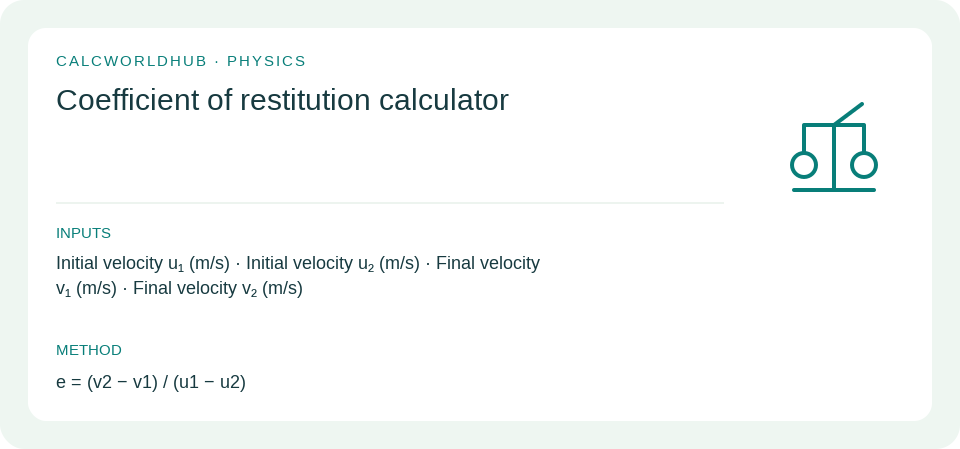
Calculate the one-dimensional coefficient of restitution from signed velocities before and after an impact.
inputs.
How to use this calculator
Calculate the one-dimensional coefficient of restitution from signed velocities before and after an impact.
- Enter Initial velocity u₁ (m/s), Initial velocity u₂ (m/s), Final velocity v₁ (m/s), Final velocity v₂ (m/s). Match the units shown beside each field and review the result together with the assumptions below.
- Read the worked example below to check the expected input format and result.
- Compare another scenario by changing one input at a time. Use Reset to return to the starting values.
How the Coefficient of restitution calculator works
Calculate the one-dimensional coefficient of restitution from signed velocities before and after an impact.
Inputs and units
- Initial velocity u₁ (m/s): Signed pre-impact velocity u1 of body 1.
- Initial velocity u₂ (m/s): Signed pre-impact velocity u2 of body 2, in the same unit.
- Final velocity v₁ (m/s): Signed post-impact velocity v1 of body 1.
- Final velocity v₂ (m/s): Signed post-impact velocity v2 of body 2; retain the same axis direction.
Formula and method
e = (v2 − v1) / (u1 − u2)
Worked example
Before velocities 5 and −2 m/s and after velocities 1 and 4 m/s give relative separation 3 m/s and approach 7 m/s: e = 3/7 = 0.4286.
Interpreting the result
This ratio compares relative separation speed after impact with relative approach speed before it. It does not by itself check momentum conservation.
Assumptions and limits
Use one fixed positive axis and consistent body numbering. Equal initial velocities make the denominator zero. A negative ratio indicates an ordering or collision-interpretation problem; e above one can represent a superelastic event.
Sources and method
- Distinguishes elastic and inelastic collisions and energy changes. The relative-velocity ratio is independently evaluated from the stated equation. OpenStax University Physics: types of collisions
Frequently asked questions
Should every velocity be positive?
No. Negative velocity represents motion opposite the selected positive axis. Taking absolute values individually can change the relative speeds incorrectly.
Must every computed coefficient lie between zero and one?
Ordinary passive impacts commonly do, but a superelastic event can exceed one. Interpret the mechanism and signed velocity ordering.
How do I use the Coefficient of restitution calculator?
Enter Initial velocity u₁ (m/s), Initial velocity u₂ (m/s), Final velocity v₁ (m/s), Final velocity v₂ (m/s). Match the units shown beside each field and review the result together with the assumptions below.
What is a worked example of Coefficient of restitution?
Before velocities 5 and −2 m/s and after velocities 1 and 4 m/s give relative separation 3 m/s and approach 7 m/s: e = 3/7 = 0.4286.
What does the Coefficient of restitution calculator calculate?
Calculate the one-dimensional coefficient of restitution from signed velocities before and after an impact.
See the calculation methodology.