Coefficient of variation calculator
Express sample standard deviation as a signed percentage of the nonzero mean.
Calculator
How to use this calculator
Calculate the signed sample coefficient of variation from sample standard deviation and a nonzero mean; interpret it only when the scale supports relative comparison.
- Enter Mean, Sample standard deviation. Match the units shown beside each field and review the result together with the assumptions below.
- Read the worked example below to check the expected input format and result.
- Compare another scenario by changing one input at a time. Use Reset to return to the starting values.
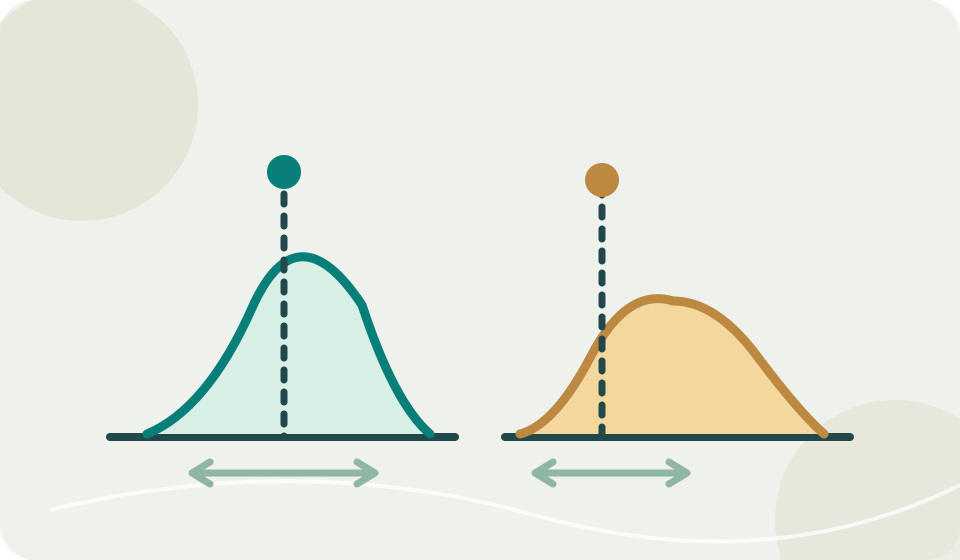
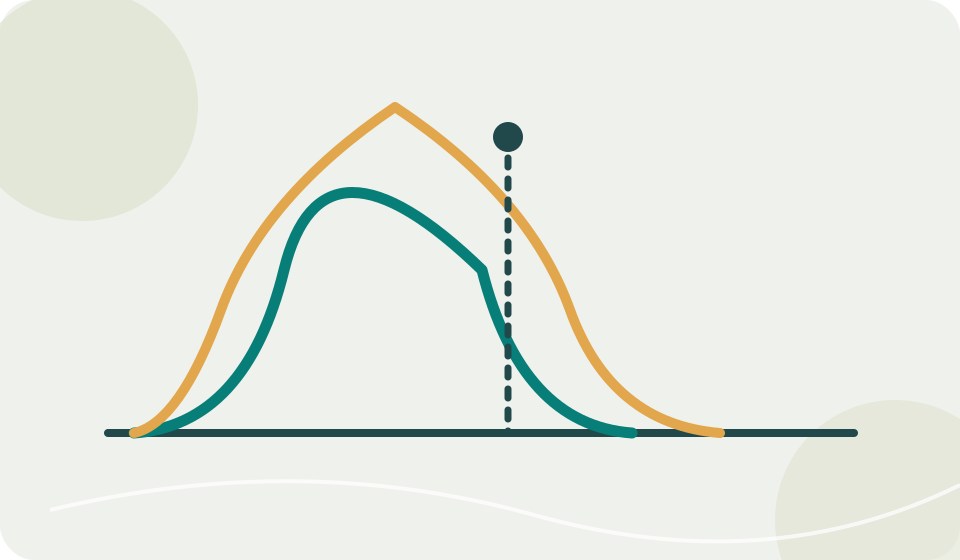
Express sample spread relative to the sample mean
The sample coefficient of variation is sample standard deviation divided by sample mean, multiplied by 100%. It retains the sign of the mean; relative interpretation is generally appropriate only for positive means on ratio scales with a meaningful zero.
Inputs and units
- Mean: Sample mean for the data being summarized; must be nonzero.
- Sample standard deviation: Sample spread measured on the same scale as the mean.
Formula and method
CV = sample standard deviation ÷ mean × 100%. The units cancel, leaving a percentage.
Worked example
For mean 50 and sample standard deviation 7.5, CV = 7.5 ÷ 50 × 100 = 15%.
Interpreting the result
With a positive mean on a meaningful ratio scale, a 15% CV means the sample standard deviation is 15% of that mean. Keep the mean visible when interpreting the signed ratio.
Assumptions and limits
A negative mean produces a negative signed ratio, and data that cross zero generally do not support a conventional CV comparison. The ratio is unstable near zero; this page does not calculate the mean or standard deviation from raw observations.
Method references
- NIST Dataplot: Coefficient of Variation
- OpenStax Introductory Business Statistics: coefficient of variation
Frequently asked questions
Why must the mean be nonzero?
The formula divides by the mean, so zero has no finite CV; values near zero can make it highly sensitive.
What if the mean is negative?
The calculator retains the sign and returns a negative ratio. Conventional CV comparisons are generally interpreted for positive means on ratio scales.
Can CV compare Celsius temperatures?
Generally not, because Celsius zero is arbitrary and ratios are not meaningful on that scale.
How do I use the Coefficient of variation calculator?
Enter Mean, Sample standard deviation. Match the units shown beside each field and review the result together with the assumptions below.
What is a worked example of Coefficient of variation?
For mean 50 and sample standard deviation 7.5, CV = 7.5 ÷ 50 × 100 = 15%.
Good calculators show their work.
CalcWorldHub is built around clear inputs and visible assumptions. Results are estimates for planning; check official sources or your provider’s terms when exact figures matter.