How to use this calculator
Compare two raters’ observed agreement with the agreement expected from their positive-rating rates.
- Enter Observed agreement pₒ (0–1), Rater 1 positive rate, Rater 2 positive rate. Match the units shown beside each field and review the result together with the assumptions below.
- Read the worked example below to check the expected input format and result.
- Compare another scenario by changing one input at a time. Use Reset to return to the starting values.
How Cohen kappa calculator works
Compare two raters’ observed agreement with the agreement expected from their positive-rating rates.
Inputs and units
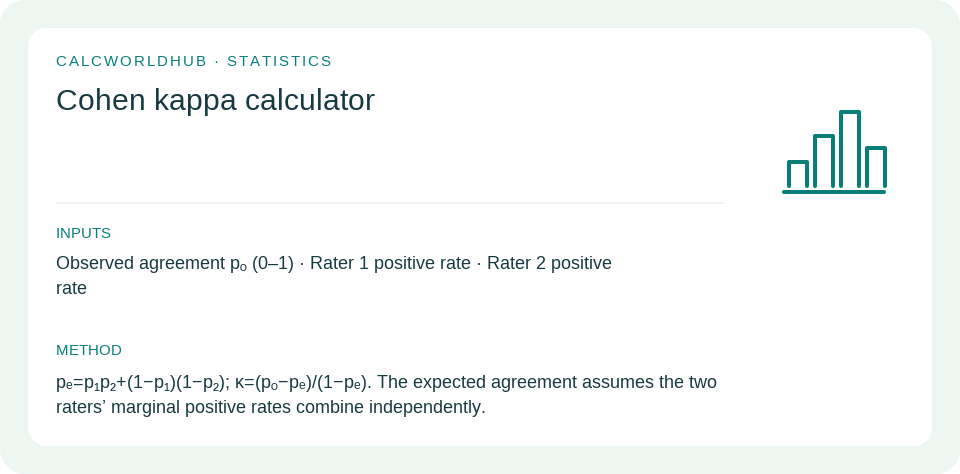
- Observed agreement pₒ (0–1): pₒ is the fraction of cases on which the raters agree.
- Rater 1 positive rate: Rater 1 positive rate is the fraction marked positive by the first rater.
- Rater 2 positive rate: Rater 2 positive rate is the fraction marked positive by the second rater.
Formula and method
pₑ=p₁p₂+(1−p₁)(1−p₂); κ=(pₒ−pₑ)/(1−pₑ). The expected agreement assumes the two raters’ marginal positive rates combine independently.
Worked example
With pₒ=0.90, p₁=0.50, and p₂=0.60, pₑ=0.30+0.20=0.50 and κ=(0.90−0.50)/(1−0.50)=0.80.
Interpreting the result
κ=0 means observed agreement equals this chance baseline; κ=1 means perfect agreement. A negative value means agreement falls below the marginal-rate baseline.
Assumptions and limits
The inputs are proportions from the same set of paired ratings. If pₑ=1, the denominator is zero and κ is undefined. Kappa does not correct every source of bias and its interpretation depends on prevalence and rating design.
Sources and method
- Cohen’s kappa compares observed agreement with expected agreement calculated under independent ratings; interpretation depends on the marginal distributions. Penn State STAT 504: Cohen’s kappa and agreement
Frequently asked questions
What does the chance baseline use?
It uses the two raters’ marginal positive and negative rates, not a universal 50% chance assumption.
Can κ be negative?
Yes. That means observed agreement is below the agreement predicted by the entered margins.
How do I use the Cohen kappa calculator?
Enter Observed agreement pₒ (0–1), Rater 1 positive rate, Rater 2 positive rate. Match the units shown beside each field and review the result together with the assumptions below.
What is a worked example of Cohen kappa?
With pₒ=0.90, p₁=0.50, and p₂=0.60, pₑ=0.30+0.20=0.50 and κ=(0.90−0.50)/(1−0.50)=0.80.
What does the Cohen kappa calculator calculate?
Compare two raters’ observed agreement with the agreement expected from their positive-rating rates.