How to use this calculator
Combine the flux of unresolved sources expressed in the same photometric band and zero-point system.
- Enter Source magnitudes in one photometric band. Match the units shown beside each field and review the result together with the assumptions below.
- Read the worked example below to check the expected input format and result.
- Compare another scenario by changing one input at a time. Use Reset to return to the starting values.
Combined apparent magnitude of unresolved sources explained
Add the sources as fluxes in one compatible band, then convert the combined flux back to apparent magnitude.
A numerical walkthrough
Source magnitudes in one photometric band = 5.2,6.1,7.4.
- Combined unresolved apparent magnitude: 4.71139841 mag
- Brightening relative to one brightest source: 0.48860159 mag
- Fraction of total flux from one brightest source: 0.637616231
- Source count: 3
Magnitudes 5.2, 6.1, and 7.4 represent unequal fluxes. Their combined magnitude must be smaller, hence brighter, than 5.2.
Flux addition gives a combined magnitude of 4.7114 mag, brighter than the brightest individual source at 5.2 mag.
The model behind the numbers
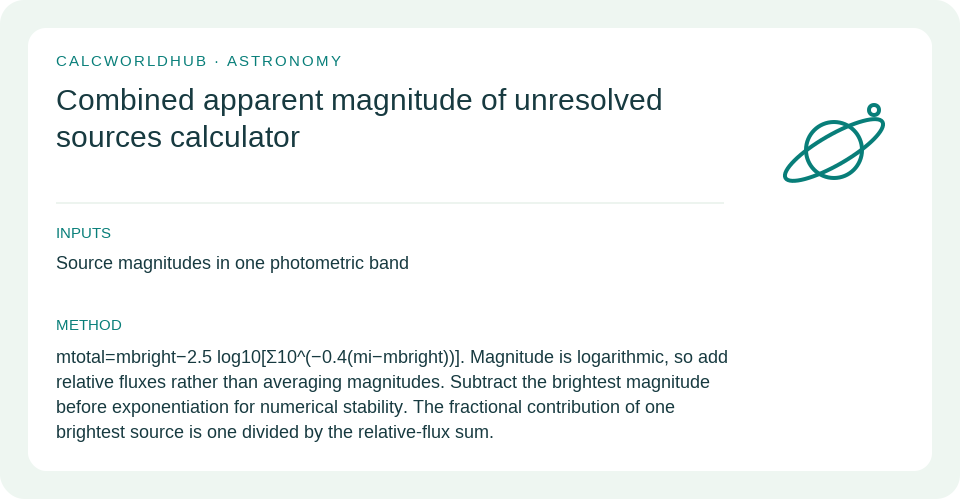
mtotal=mbright−2.5 log10[Σ10^(−0.4(mi−mbright))].
Magnitude is logarithmic, so add relative fluxes rather than averaging magnitudes. Subtract the brightest magnitude before exponentiation for numerical stability. The fractional contribution of one brightest source is one divided by the relative-flux sum.
What to enter
m— Source magnitudes in one photometric band- Magnitudes in one compatible photometric band and zero-point system. Fluxes add; magnitude values are not averaged. Use comma-separated values in the stated order.
Interpreting the result
Assumes additive fluxes measured in one compatible band and magnitude zero-point system. Color conversion, extinction correction, variability, blending bias and spatial-resolution effects are not modeled.
Reading the outputs
Brightening is a positive magnitude difference relative to one brightest source. If several sources tie for brightest, the displayed fraction refers to one of them.
Frequently asked questions
Can I average the three magnitudes?
No. Convert to flux weights, sum them, and convert back.
Can bands be mixed?
No. Different photometric bands measure different spectral weightings.
What if I combine two identical sources?
The combined magnitude is about 0.7526 lower than either individual magnitude.
How do I use the Combined apparent magnitude of unresolved sources calculator?
Enter Source magnitudes in one photometric band. Match the units shown beside each field and review the result together with the assumptions below.
What is a worked example of Combined apparent magnitude of unresolved sources?
Source magnitudes in one photometric band = 5.2,6.1,7.4. Combined unresolved apparent magnitude: 4.71139841 mag Brightening relative to one brightest source: 0.48860159 mag Fraction of total flux from one brightest source: 0.637616231 Source count: 3 Magnitudes 5.2, 6.1, and 7.4 represent unequal fluxes. Their combined magnitude must be smaller, hence brighter, than 5.2. Flux addition gives a combined magnitude of 4.7114 mag, brighter than the brightest individual source at 5.2 mag.
Read our calculation methodology.