How to use this calculator
Apply an explicit reversible-inhibition model and inspect apparent Vmax and Km under the same inhibitor concentration.
- Enter Uninhibited Vmax (concentration/min), Michaelis constant in concentration units, Substrate concentration, Free inhibitor concentration, then complete the remaining labeled fields. Match the units shown beside each field and review the result together with the assumptions below.
- Read the worked example below to check the expected input format and result.
- Compare another scenario by changing one input at a time. Use Reset to return to the starting values.
Competitive uncompetitive mixed enzyme inhibition explained
Competitive, uncompetitive, and mixed inhibition change the free-enzyme and enzyme–substrate terms in different ways. The selected model determines the apparent kinetic parameters as well as the inhibited rate.
Inputs, symbols, and units
v— Uninhibited Vmax (concentration/min)- Uninhibited Vmax (concentration/min).
km— Michaelis constant in concentration units- Michaelis constant in concentration units.
s— Substrate concentration- Substrate concentration.
i— Free inhibitor concentration- Free inhibitor concentration.
ki— Inhibitor constant for free enzyme- Inhibitor constant for free enzyme.
kip— Inhibitor constant for enzyme-substrate complex- Inhibitor constant for enzyme-substrate complex.
m— Inhibition pattern- Inhibition pattern. Choose competitive, uncompetitive, mixed, noncompetitive.
Formula and method
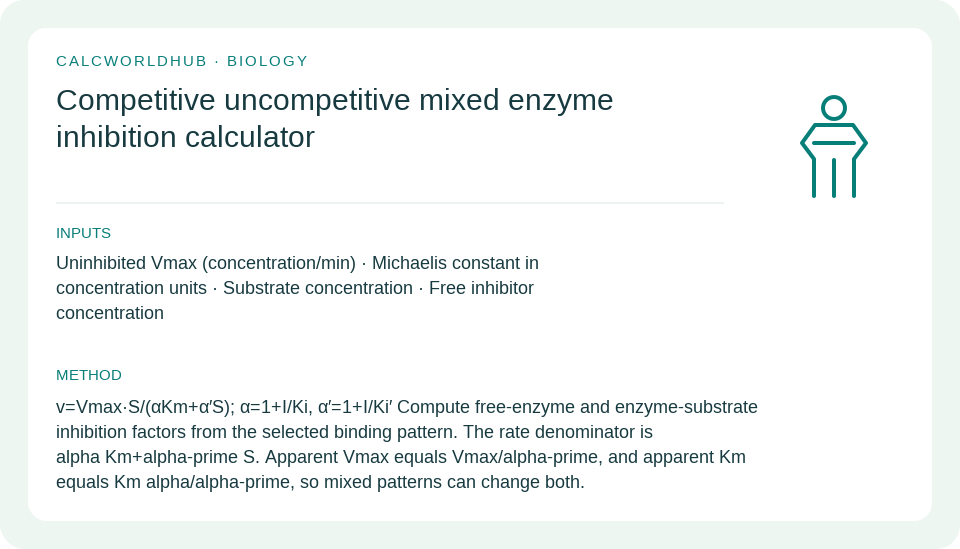
v=Vmax·S/(αKm+α′S); α=1+I/Ki, α′=1+I/Ki′
Compute free-enzyme and enzyme-substrate inhibition factors from the selected binding pattern. The rate denominator is alpha Km+alpha-prime S. Apparent Vmax equals Vmax/alpha-prime, and apparent Km equals Km alpha/alpha-prime, so mixed patterns can change both.
A worked scenario
Uninhibited Vmax (concentration/min) = 100; Michaelis constant in concentration units = 2; Substrate concentration = 4; Free inhibitor concentration = 5; Inhibitor constant for free enzyme = 10; Inhibitor constant for enzyme-substrate complex = 20; Inhibition pattern = competitive.
- Inhibited reaction rate: 57.14285714 concentration/min
- Apparent Vmax: 100 concentration/min
- Apparent Km: 3 concentration units
Competitive factor alpha is 1+5/10=1.5 and alpha-prime is one. Rate is 100×4/(1.5×2+4)=57.14285714 concentration units per minute.
Assumptions and edge cases
Rapid-equilibrium steady-state model with fixed free inhibitor; irreversible inhibition, tight-binding inhibitor depletion, and cooperativity are excluded. Noncompetitive mode sets both factors using Ki.
Frequently asked questions
Which constant is used in competitive mode?
Only Ki for free enzyme; alpha-prime is one.
Does mixed inhibition always leave Km unchanged?
No, apparent Km changes by alpha/alpha-prime.
Is free inhibitor always equal to added inhibitor?
Not when binding substantially depletes it.
How do I use the Competitive uncompetitive mixed enzyme inhibition calculator?
Enter Uninhibited Vmax (concentration/min), Michaelis constant in concentration units, Substrate concentration, Free inhibitor concentration, then complete the remaining labeled fields. Match the units shown beside each field and review the result together with the assumptions below.
What is a worked example of Competitive uncompetitive mixed enzyme inhibition?
Uninhibited Vmax (concentration/min) = 100; Michaelis constant in concentration units = 2; Substrate concentration = 4; Free inhibitor concentration = 5; Inhibitor constant for free enzyme = 10; Inhibitor constant for enzyme-substrate complex = 20; Inhibition pattern = competitive. Inhibited reaction rate: 57.14285714 concentration/min Apparent Vmax: 100 concentration/min Apparent Km: 3 concentration units Competitive factor alpha is 1+5/10=1.5 and alpha-prime is one. Rate is 100×4/(1.5×2+4)=57.14285714 concentration units per minute.
Read our calculation methodology.