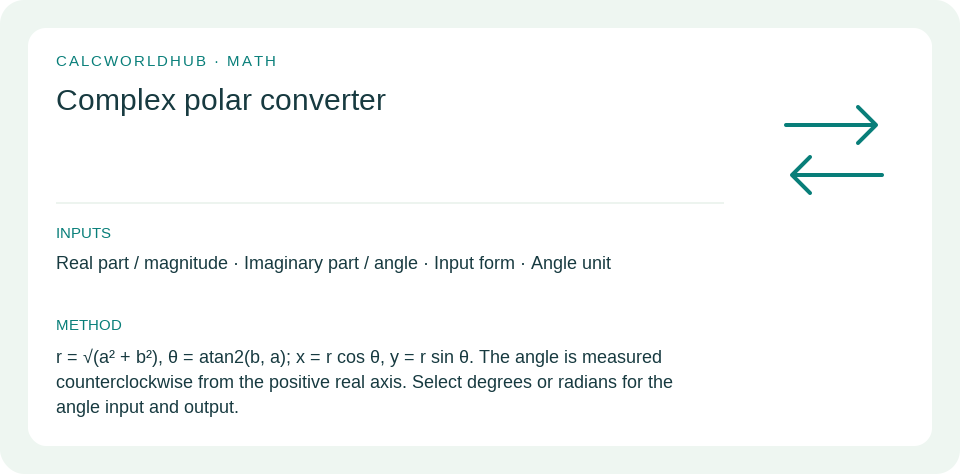
How to use this calculator
Convert a complex number between rectangular coordinates a + bi and polar form r∠θ.
- Enter Real part / magnitude, Imaginary part / angle, Input form, Angle unit. Match the units shown beside each field and review the result together with the assumptions below.
- Read the worked example below to check the expected input format and result.
- Compare another scenario by changing one input at a time. Use Reset to return to the starting values.
How this calculation works
Convert between rectangular coordinates a + bi and polar form r∠θ. The magnitude is the distance from the origin, and the angle is measured counterclockwise from the positive real axis; choose degrees or radians for angle input and output.
Inputs and meanings
x— Real part / magnitude- For rectangular input, this is the real part. For polar input, this is the nonnegative magnitude.
y— Imaginary part / angle- For rectangular input, this is the imaginary part. For polar input, this is the angle.
mode— Input form- Choose rectangular or polar input.
angleUnit— Angle unit- Choose the unit used by the angle.
Formula and method
r = √(a² + b²), θ = atan2(b, a); x = r cos θ, y = r sin θ.
The angle is measured counterclockwise from the positive real axis. Select degrees or radians for the angle input and output.
Worked example
Convert a complex number between rectangular coordinates a + bi and polar form r∠θ.
For 3 + 4i, magnitude is √(3² + 4²) = 5 and the argument is atan2(4,3) ≈ 53.1301°.
Assumptions and limits
At the origin the angle is conventionally reported as zero. The selected angle unit affects display and polar input only.
Frequently asked questions
What is the difference between rectangular and polar form?
Rectangular form gives real and imaginary components. Polar form gives a magnitude and an angle.
Are angles measured clockwise?
No. Positive angles are measured counterclockwise from the positive real axis.
Can the magnitude be negative?
No. A magnitude is zero or positive; a negative radius can be represented by adding 180° to the angle and using a positive magnitude.
How do I use the Complex polar converter?
Enter Real part / magnitude, Imaginary part / angle, Input form, Angle unit. Match the units shown beside each field and review the result together with the assumptions below.
What is a worked example of Complex polar converter?
Convert a complex number between rectangular coordinates a + bi and polar form r∠θ. For 3 + 4i, magnitude is √(3² + 4²) = 5 and the argument is atan2(4,3) ≈ 53.1301°.
Read our calculation methodology.