Compressed file transfer time calculator
Estimate the ideal time to send a known compressed file size at a stated sustained rate.
inputs.
Calculator
How to use this calculator
Estimate ideal transfer time from compressed file size and sustained throughput; protocol and storage overhead are excluded.
- Enter Compressed data size (MB), Transfer rate (MB/s). Match the units shown beside each field and review the result together with the assumptions below.
- Read the worked example below to check the expected input format and result.
- Compare another scenario by changing one input at a time. Use Reset to return to the starting values.
Estimate ideal transfer time for the compressed file
Divide the compressed file size by the sustained transfer rate. The result is a throughput-based lower-bound estimate; it does not include protocol overhead, latency, retransmissions, or storage delays.
Inputs and units
- Compressed data size (MB): The size of the file that will actually be sent.
- Transfer rate (MB/s): Sustained throughput in megabytes per second; use the same MB convention for both inputs.
Formula and method
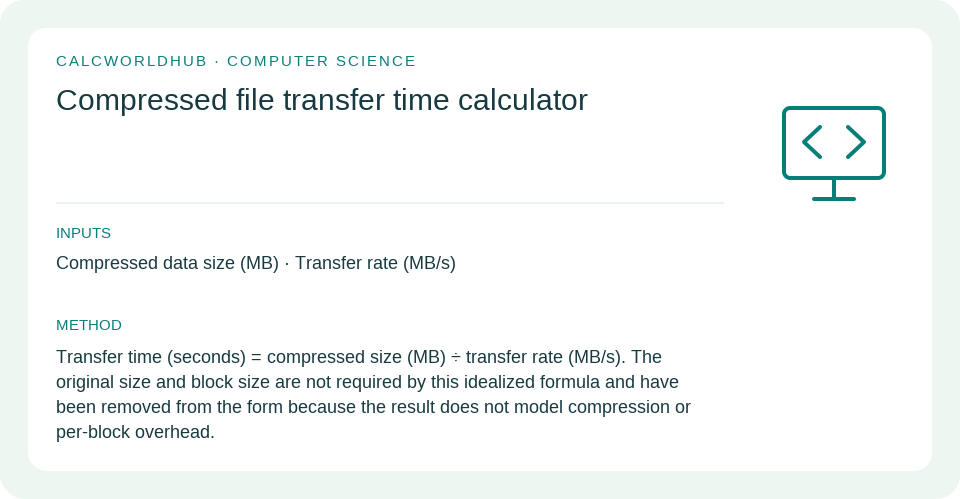
Transfer time (seconds) = compressed size (MB) ÷ transfer rate (MB/s). The original size and block size are not required by this idealized formula and have been removed from the form because the result does not model compression or per-block overhead.
Worked example
A 62 MB compressed file sent at 12 MB/s takes 62 ÷ 12 = 5.1667 seconds in the idealized calculation.
Interpreting the result
Treat the result as a baseline for comparing sizes or rates. Real transfers take longer when the observed throughput is below the stated rate or when connection setup, protocol overhead, congestion, retries, or disk I/O are material.
Assumptions and limits
The calculator assumes a steady rate and matching size/rate units. MB can mean decimal megabytes or be used informally for MiB; use the same convention in both fields. If the rate is in megabits per second, convert it to megabytes per second first.
Method references
Frequently asked questions
Why is the original file size not used?
Once the compressed file size is known, transfer time depends on that transmitted size and the transfer rate. Original size is useful for compression-ratio analysis, but it does not change this time estimate.
How do I use the Compressed file transfer time calculator?
Enter Compressed data size (MB), Transfer rate (MB/s). Match the units shown beside each field and review the result together with the assumptions below.
What is a worked example of Compressed file transfer time?
A 62 MB compressed file sent at 12 MB/s takes 62 ÷ 12 = 5.1667 seconds in the idealized calculation.
What does the Compressed file transfer time calculator calculate?
Estimate ideal transfer time from compressed file size and sustained throughput; protocol and storage overhead are excluded.
What assumptions apply to Compressed file transfer time?
The calculator assumes a steady rate and matching size/rate units. MB can mean decimal megabytes or be used informally for MiB; use the same convention in both fields. If the rate is in megabits per second, convert it to megabytes per second first.
Good calculators show their work.
CalcWorldHub is built around clear inputs and visible assumptions. Results are estimates for planning; check official sources or your provider’s terms when exact figures matter.