How to use this calculator
Find the wavelength shift, outgoing photon energy, and electron recoil kinetic energy in free-electron Compton scattering.
- Enter Incident vacuum wavelength (pm), Photon scattering angle (degrees). Match the units shown beside each field and review the result together with the assumptions below.
- Read the worked example below to check the expected input format and result.
- Compare another scenario by changing one input at a time. Use Reset to return to the starting values.
Compton photon scattering and recoil energy explained
For a photon scattered by an electron initially at rest, the wavelength shift depends only on the scattering angle and the electron Compton wavelength. The incident wavelength then determines the photon energy before and after scattering and the electron’s recoil energy.
Inputs, symbols, and units
lambda— Incident vacuum wavelength (pm)- Incident photon wavelength in picometres, measured in vacuum.
theta— Photon scattering angle (degrees)- Angle between incident and scattered photon propagation directions, in degrees.
Formula and method
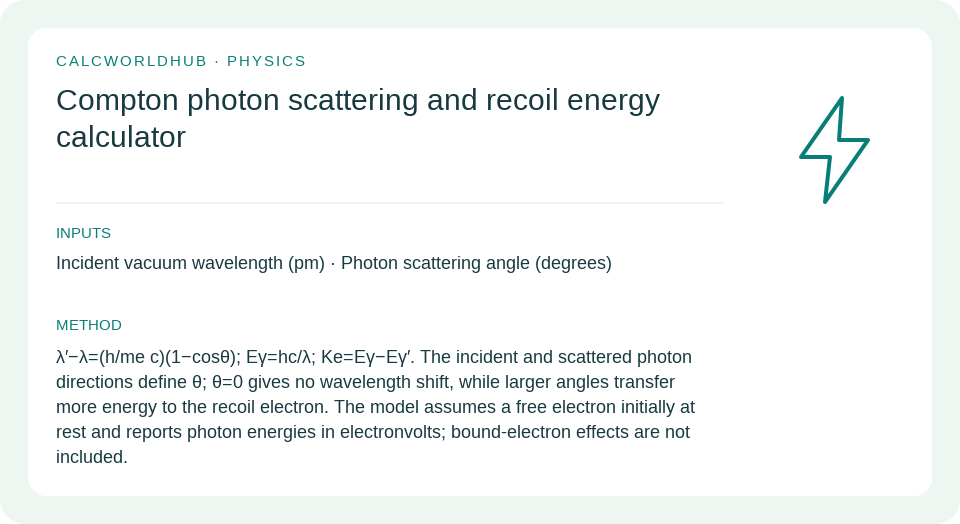
λ′−λ=(h/me c)(1−cosθ); Eγ=hc/λ; Ke=Eγ−Eγ′.
The incident and scattered photon directions define θ; θ=0 gives no wavelength shift, while larger angles transfer more energy to the recoil electron. The model assumes a free electron initially at rest and reports photon energies in electronvolts; bound-electron effects are not included.
A worked scenario
Incident vacuum wavelength (pm) = 50; Photon scattering angle (degrees) = 75.
- Compton wavelength shift: 1.798334937 pm
- Scattered photon wavelength: 51.798334937 pm
- Scattered photon energy: 23935.94284134 eV
- Recoil electron kinetic energy: 860.8968453 eV
A fifty-picometre photon scatters through seventy-five degrees. Its wavelength increases and the missing photon energy appears as electron recoil kinetic energy.
Assumptions and edge cases
A free stationary electron and one isolated scattering event. Binding, electron thermal motion, multiple scattering, material attenuation, and interaction probability are not modeled.
Reading the outputs
Zero angle gives zero wavelength shift and no recoil energy. This is a kinematic calculation, not a scattering cross-section or radiation-dose calculation.
Frequently asked questions
Why does wavelength increase?
The photon transfers energy to the initially stationary electron.
Is this an optical diffraction angle?
No. It is the photon direction change in a particle scattering event.
Can it predict how often scattering occurs?
No. That requires a cross-section and target model.
How do I use the Compton photon scattering and recoil energy calculator?
Enter Incident vacuum wavelength (pm), Photon scattering angle (degrees). Match the units shown beside each field and review the result together with the assumptions below.
What is a worked example of Compton photon scattering and recoil energy?
Incident vacuum wavelength (pm) = 50; Photon scattering angle (degrees) = 75. Compton wavelength shift: 1.798334937 pm Scattered photon wavelength: 51.798334937 pm Scattered photon energy: 23935.94284134 eV Recoil electron kinetic energy: 860.8968453 eV A fifty-picometre photon scatters through seventy-five degrees. Its wavelength increases and the missing photon energy appears as electron recoil kinetic energy.
Background or definition reference: OpenStax Compton scattering.
Read our calculation methodology.