How to use this calculator
Accumulate concrete temperature-time maturity from curing intervals and express the index as equivalent age at a chosen temperature.
- Enter Interval durations (hours), Mean concrete temperatures (°C), Nurse–Saul datum temperature (°C), Equivalent-age reference temperature (°C). Match the units shown beside each field and review the result together with the assumptions below.
- Read the worked example below to check the expected input format and result.
- Compare another scenario by changing one input at a time. Use Reset to return to the starting values.
How this calculation works
Concrete maturity condenses a measured temperature history into a time-temperature index. Enter the duration and mean concrete temperature for each interval, then choose a reference temperature if you want the index expressed as equivalent curing age.
Inputs and units
durationsHours— Interval durations (hours)- Comma-, space-, or line-separated durations; align each value with one mean concrete temperature below.
meanTempsC— Mean concrete temperatures (°C)- One average concrete temperature for each monitoring interval, in the same order as the durations.
datumC— Nurse–Saul datum temperature (°C)- Use the datum selected for the concrete mixture and maturity procedure.
referenceC— Equivalent-age reference temperature (°C)- Temperature at which the equivalent curing age is expressed; it must be above the datum.
Formula
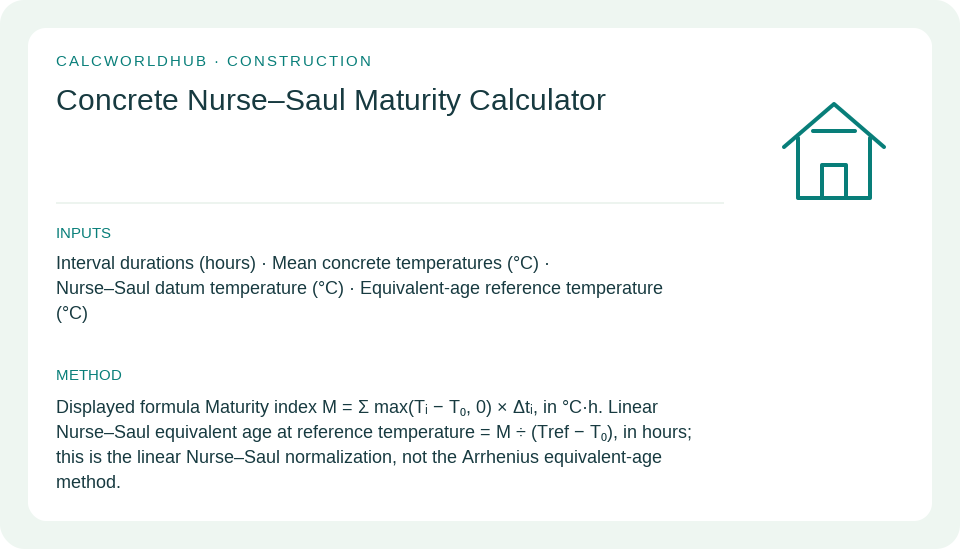
Maturity index M = Σ max(Tᵢ − T₀, 0) × Δtᵢ, in °C·h. Linear Nurse–Saul equivalent age at reference temperature = M ÷ (Tref − T₀), in hours; this is the linear Nurse–Saul normalization, not the Arrhenius equivalent-age method.
Method
For each interval, temperature above the selected datum is multiplied by its duration. Intervals at or below the datum contribute zero. The displayed reference-temperature age divides the accumulated Nurse–Saul index by the reference temperature rise above the datum; this is a linear Nurse–Saul normalization, distinct from Arrhenius equivalent age.
Worked example
For 12 h at 15°C, 12 h at 20°C, 24 h at 25°C, and 24 h at 20°C with a −10°C datum, M = 12×25 + 12×30 + 24×35 + 24×30 = 2,220°C·h. At a 20°C reference, linear Nurse–Saul equivalent age = 2,220 ÷ 30 = 74 h.
Assumptions and limits
Maturity is not a direct compressive-strength result. Strength estimates require a maturity-strength relationship calibrated for the specific concrete mixture and field procedure. The reference-temperature age here uses the linear Nurse–Saul model, not the Arrhenius equivalent-age method. Do not use this page alone to decide safe form removal, loading, or opening time.
Frequently asked questions
What does the maturity index measure?
It summarizes the entered time and concrete-temperature history relative to a selected datum; it is an index, not a strength measurement.
Can this tell me when concrete is safe to load?
Not by itself. Strength decisions need mixture-specific calibration and project procedures; verify with the responsible engineer and applicable specifications.
Is −10°C the right datum for every mix?
No. Use the datum associated with the method and mixture calibration you rely on; it is not a universal material constant.
Is this the Arrhenius equivalent-age method?
No. The displayed age is a linear normalization of the Nurse–Saul index at the selected reference temperature. An Arrhenius equivalent-age calculation uses a different temperature weighting.
How do I use the Concrete Nurse–Saul Maturity Calculator?
Enter Interval durations (hours), Mean concrete temperatures (°C), Nurse–Saul datum temperature (°C), Equivalent-age reference temperature (°C). Match the units shown beside each field and review the result together with the assumptions below.
Reference: Federal Highway Administration technical brief on concrete maturity testing. See our calculation methodology.