How to use this calculator
Estimate the flame-temperature trend with excess air using a transparent energy balance and user-supplied average product heat capacities.
- Enter Fuel carbon atoms, Fuel hydrogen atoms, Air equivalence ratio lambda, Fuel and air inlet temperature (K), then complete the remaining labeled fields. Match the units shown beside each field and review the result together with the assumptions below.
- Read the worked example below to check the expected input format and result.
- Compare another scenario by changing one input at a time. Use Reset to return to the starting values.
Constant heat-capacity adiabatic hydrocarbon flame explained
This idealized energy balance estimates the adiabatic temperature for complete combustion of a CxHy fuel with air. It distributes the fuel heating value across CO₂, H₂O, excess O₂, and N₂ using the supplied constant heat capacities, with no dissociation, heat loss, or temperature-dependent Cp.
Inputs, symbols, and units
C— Fuel carbon atoms- Fuel carbon atoms. Enter the value for this state; the units shown are used without an unstated conversion.
H— Fuel hydrogen atoms- Fuel hydrogen atoms. Enter the value for this state; the units shown are used without an unstated conversion.
lam— Air equivalence ratio lambda- Air equivalence ratio lambda. Enter the value for this state; the units shown are used without an unstated conversion.
Tin— Fuel and air inlet temperature (K)- Fuel and air inlet temperature (K). Enter the value for this state; the units shown are used without an unstated conversion.
LHV— Fuel lower heating value (kJ/mol fuel)- Fuel lower heating value (kJ/mol fuel). Enter the value for this state; the units shown are used without an unstated conversion.
cCO2— Average CO2 molar cp (kJ/mol/K)- Average CO2 molar cp (kJ/mol/K). Enter the value for this state; the units shown are used without an unstated conversion.
cH2O— Average water-vapor molar cp (kJ/mol/K)- Average water-vapor molar cp (kJ/mol/K). Enter the value for this state; the units shown are used without an unstated conversion.
cO2— Average oxygen molar cp (kJ/mol/K)- Average oxygen molar cp (kJ/mol/K). Enter the value for this state; the units shown are used without an unstated conversion.
cN2— Average nitrogen molar cp (kJ/mol/K)- Average nitrogen molar cp (kJ/mol/K). Enter the value for this state; the units shown are used without an unstated conversion.
Formula and method
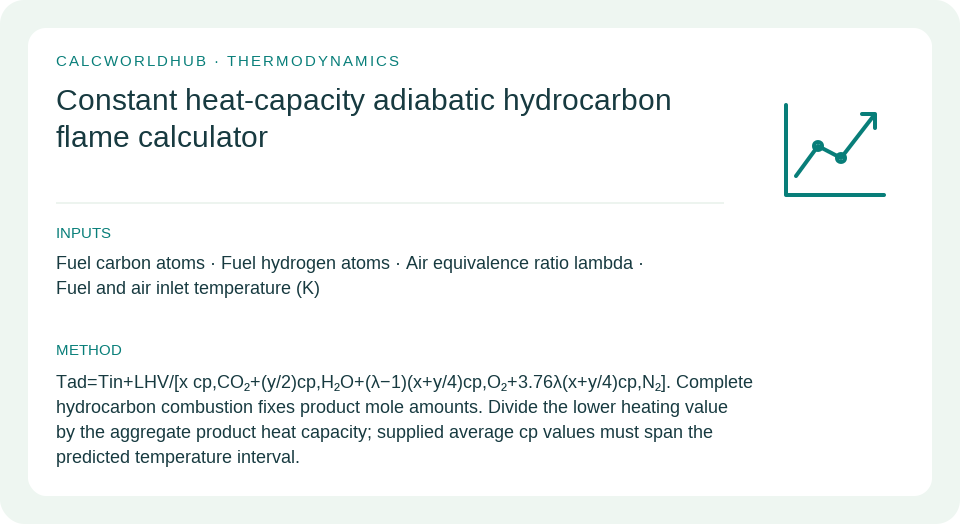
Tad=Tin+LHV/[x cp,CO₂+(y/2)cp,H₂O+(λ−1)(x+y/4)cp,O₂+3.76λ(x+y/4)cp,N₂].
Complete hydrocarbon combustion fixes product mole amounts. Divide the lower heating value by the aggregate product heat capacity; supplied average cp values must span the predicted temperature interval.
A worked scenario
Fuel carbon atoms = 1; Fuel hydrogen atoms = 4; Air equivalence ratio lambda = 1.2; Fuel and air inlet temperature (K) = 298.15; Fuel lower heating value (kJ/mol fuel) = 802.3; Average CO2 molar cp (kJ/mol/K) = 0.05; Average water-vapor molar cp (kJ/mol/K) = 0.042; Average oxygen molar cp (kJ/mol/K) = 0.035; Average nitrogen molar cp (kJ/mol/K) = 0.033.
- Approximate adiabatic flame temperature: 2097.868254 K
- Product heat capacity per fuel mole: 0.445792 kJ/mol fuel/K
- Excess oxygen per fuel mole: 0.4 mol/mol
For methane with 20% excess air, 802.3 kJ/mol lower heating value and the entered constant product heat capacities, the ideal balance reaches 2,097.87 K from 298.15 K. Product heat-capacity flow per fuel mole is 0.445792 kJ/mol/K; this simplified result omits dissociation.
Assumptions and edge cases
No dissociation, incomplete combustion, radiation loss or temperature-dependent integration. Large predicted temperatures need equilibrium chemistry rather than interpreting this as a measured flame temperature.
Reading the outputs
Temperature is an approximate adiabatic product temperature; heat capacity is per fuel mole and leftover oxygen is mol/mol fuel.
Frequently asked questions
Should HHV or LHV be used?
Use LHV because the products include water vapor rather than condensed liquid water.
Why are average heat capacities inputs?
A constant-cp estimate is only useful when the averages represent the expected hot-product range.
Does excess air always lower the estimate?
For the same inlet temperature and fuel input, extra oxygen and nitrogen increase heat capacity and lower this model temperature.
How do I use the Constant heat-capacity adiabatic hydrocarbon flame calculator?
Enter Fuel carbon atoms, Fuel hydrogen atoms, Air equivalence ratio lambda, Fuel and air inlet temperature (K), then complete the remaining labeled fields. Match the units shown beside each field and review the result together with the assumptions below.
What is a worked example of Constant heat-capacity adiabatic hydrocarbon flame?
Fuel carbon atoms = 1; Fuel hydrogen atoms = 4; Air equivalence ratio lambda = 1.2; Fuel and air inlet temperature (K) = 298.15; Fuel lower heating value (kJ/mol fuel) = 802.3; Average CO2 molar cp (kJ/mol/K) = 0.05; Average water-vapor molar cp (kJ/mol/K) = 0.042; Average oxygen molar cp (kJ/mol/K) = 0.035; Average nitrogen molar cp (kJ/mol/K) = 0.033. Approximate adiabatic flame temperature: 2097.868254 K Product heat capacity per fuel mole: 0.445792 kJ/mol fuel/K Excess oxygen per fuel mole: 0.4 mol/mol For methane with 20% excess air, 802.3 kJ/mol lower heating value and the entered constant product heat capacities, the ideal balance reaches 2,097.87 K from 298.15 K.
Read our calculation methodology.