Corrugated box strength calculator
This screening estimate relates edge-crush strength and board geometry to an approximate top-to-bottom compression load for a regular slotted container.
inputs.
Calculator
How to use this calculator
Estimate corrugated box compression strength with a McKee-style model using edge-crush strength, board caliper, box dimensions, and a safety factor.
- Complete the labeled inputs for Corrugated box strength. Use the units requested by each field, then read the displayed result alongside the method and limits below.
- Read the worked example below to check the expected input format and result.
- Compare another scenario by changing one input at a time. Use Reset to return to the starting values.
What the box-strength estimate represents
Formula and method
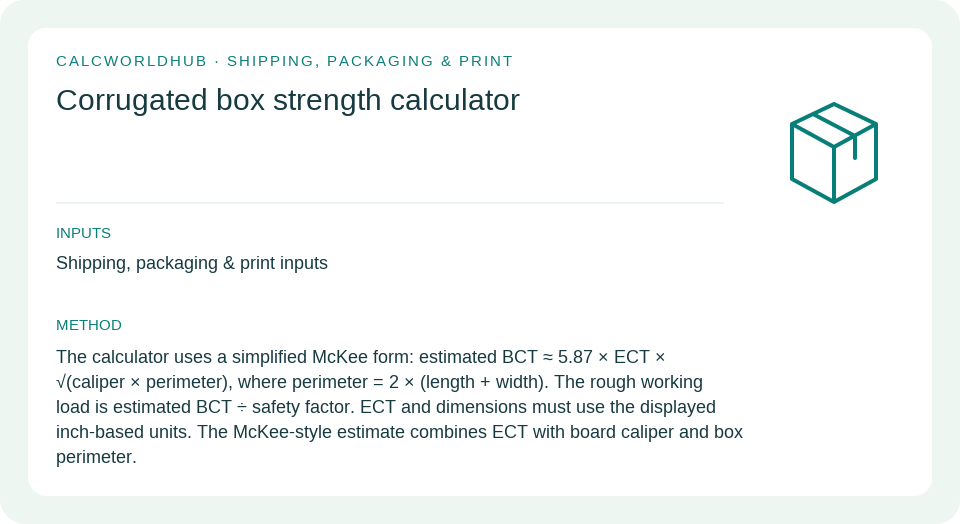
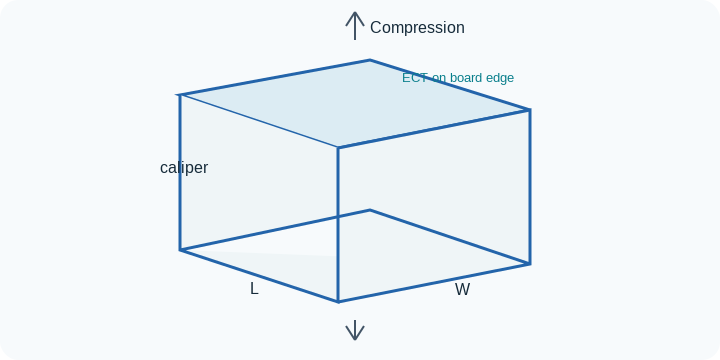
The calculator uses a simplified McKee form: estimated BCT ≈ 5.87 × ECT × √(caliper × perimeter), where perimeter = 2 × (length + width). The rough working load is estimated BCT ÷ safety factor. ECT and dimensions must use the displayed inch-based units.
Worked example
For ECT 32 lb/in, a 16 × 12 in box, and 0.16 in board caliper, perimeter is 56 in. The estimate is 5.87 × 32 × √(0.16 × 56) ≈ 562 lb. A factor of 5 gives a rough working load of about 112 lb.
Interpreting the result
The estimated BCT is a comparative screening value for the model inputs. The divided working-load figure gives a conservative planning allowance based on the chosen factor.
Assumptions and limits
Board grade, flute profile, humidity, box openings, print, scoring, storage duration, pallet pattern, and load distribution affect actual performance. A model estimate cannot replace a conditioned compression test or supplier specification.
Sources and method notes
Read our calculation methodology.
Frequently asked questions
How do I use the Corrugated box strength calculator?
Complete the labeled inputs for Corrugated box strength. Use the units requested by each field, then read the displayed result alongside the method and limits below.
What is a worked example of Corrugated box strength?
For ECT 32 lb/in, a 16 × 12 in box, and 0.16 in board caliper, perimeter is 56 in. The estimate is 5.87 × 32 × √(0.16 × 56) ≈ 562 lb. A factor of 5 gives a rough working load of about 112 lb.
What does the Corrugated box strength calculator calculate?
Estimate corrugated box compression strength with a McKee-style model using edge-crush strength, board caliper, box dimensions, and a safety factor.
What assumptions apply to Corrugated box strength?
Board grade, flute profile, humidity, box openings, print, scoring, storage duration, pallet pattern, and load distribution affect actual performance. A model estimate cannot replace a conditioned compression test or supplier specification.
Which method does the Corrugated box strength calculator use?
The calculator uses a simplified McKee form: estimated BCT ≈ 5.87 × ECT × √(caliper × perimeter), where perimeter = 2 × (length + width). The rough working load is estimated BCT ÷ safety factor. ECT and dimensions must use the displayed inch-based units. The McKee-style estimate combines ECT with board caliper and box perimeter.
Good calculators show their work.
CalcWorldHub is built around clear inputs and visible assumptions. Results are estimates for planning; check official sources or your provider’s terms when exact figures matter.