Cost of quality calculator
Add prevention, appraisal, internal-failure, and external-failure costs. Enter your values below for a free estimate, with no account required.
inputs.
Calculator
How to use this calculator
Free Cost of quality calculator. Add prevention, appraisal, internal-failure, and external-failure costs.
- Enter Prevention costs ($), Appraisal costs ($), Internal failure costs ($), External failure costs ($), then complete the remaining labeled fields. Match the units shown beside each field and review the result together with the assumptions below.
- Read the worked example below to check the expected input format and result.
- Compare another scenario by changing one input at a time. Use Reset to return to the starting values.
Add and interpret cost-of-quality categories
Sum prevention, appraisal, internal-failure, and external-failure costs. The optional sales field converts that same-period total into a percentage of revenue; it does not change the total cost.
What it calculates
Total quality cost is the sum of four accounting categories. If sales revenue is positive, the second output is total quality cost divided by sales for the same reporting period. This is a cost classification and comparison, not a defect rate or per-unit yield measure.
Inputs and units
- Prevention costs ($)
- Spending intended to prevent quality problems, such as quality planning or preventive training.
- Appraisal costs ($)
- Inspection, testing, auditing, and other measurement used to assess conformance.
- Internal failure costs ($)
- Scrap, rework, or failure analysis for problems found before delivery.
- External failure costs ($)
- Warranty, returns, repair, and complaint costs for problems found after delivery.
- Sales revenue for same period ($, optional)
- Revenue for the reporting period used for the cost inputs. It is only a denominator for the percentage output.
Formula and worked example
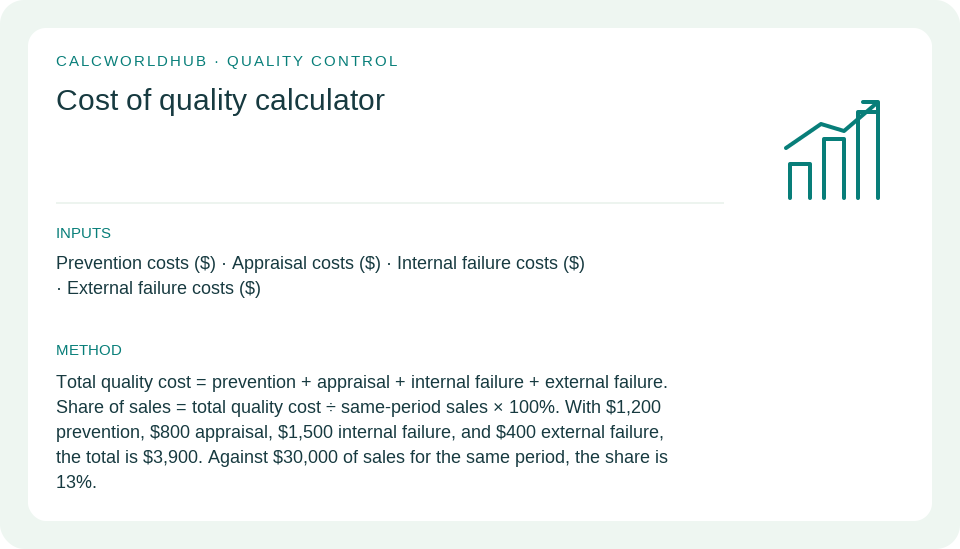
Total quality cost = prevention + appraisal + internal failure + external failure. Share of sales = total quality cost ÷ same-period sales × 100%.
With $1,200 prevention, $800 appraisal, $1,500 internal failure, and $400 external failure, the total is $3,900. Against $30,000 of sales for the same period, the share is 13%.
Reading the result
The total combines the entered categories; it does not show whether spending prevents future failures or whether one category is economically optimal. Compare like-for-like periods and review the underlying classification before interpreting changes.
Assumptions and limitations
Use one currency and reporting period, classify each expense once, and follow a stable accounting policy. Negative inputs are not costs in this model. If sales are zero or omitted, the total remains valid but the percentage is not calculated.
Source and method reference
ASQ describes prevention and appraisal costs and distinguishes internal from external failure costs. American Society for Quality: Cost of Quality.
Frequently asked questions
What belongs in prevention costs?
Examples include quality planning, process design, and preventive training. Use consistent organization-level accounting definitions and count each expense once.
Are warranty claims internal or external failure costs?
They are generally external failure costs because they arise after delivery; apply the accounting policy used for your reports.
Why must the sales period match?
The share is meaningful only when total quality costs and sales use the same currency and reporting period.
How do I use the Cost of quality calculator?
Enter Prevention costs ($), Appraisal costs ($), Internal failure costs ($), External failure costs ($), then complete the remaining labeled fields. Match the units shown beside each field and review the result together with the assumptions below.
What is a worked example of Cost of quality?
Total quality cost = prevention + appraisal + internal failure + external failure. Share of sales = total quality cost ÷ same-period sales × 100%. With $1,200 prevention, $800 appraisal, $1,500 internal failure, and $400 external failure, the total is $3,900. Against $30,000 of sales for the same period, the share is 13%.
Read the calculation methodology.
Good calculators show their work.
CalcWorldHub is built around clear inputs and visible assumptions. Results are estimates for planning; check official sources or your provider’s terms when exact figures matter.