Coterminal angle calculator
Normalize any angle to its equivalent in the range from zero up to 360 degrees. Enter your numbers below to see the result and method.
inputs.
Related calculators and articles
Compare methods and explore more free tools in math.
How to use this calculator
Free Coterminal angle calculator. Normalize any angle to its equivalent in the range from zero up to 360 degrees. Review the formula and assumptions.
- Enter Angle (degrees). Match the units shown beside each field and review the result together with the assumptions below.
- Read the worked example below to check the expected input format and result.
- Compare another scenario by changing one input at a time. Use Reset to return to the starting values.
Normalize degrees by complete turns
This calculator returns one representative of an angle in the half-open range [0°, 360°). It accepts negative angles and angles larger than one turn.
Input and unit
- Angle (degrees): Enter a finite signed angle in degrees. Convert radians to degrees before using this page.
Formula and method
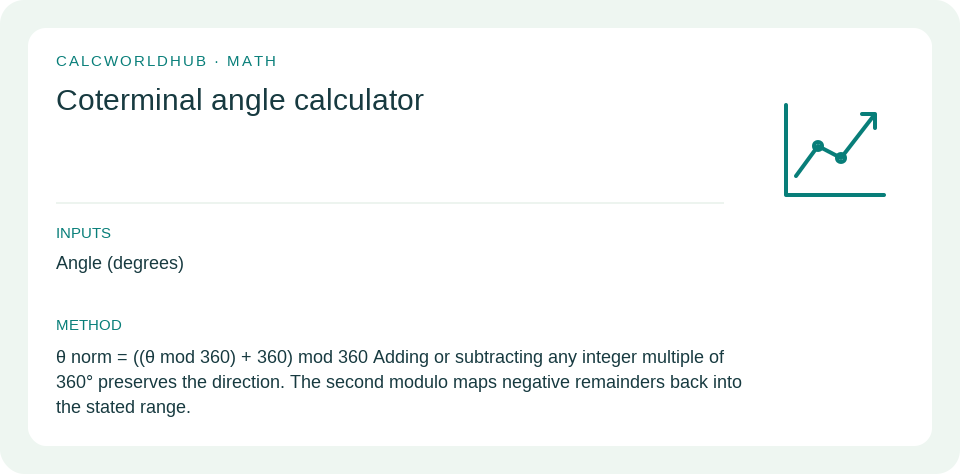
θnorm = ((θ mod 360) + 360) mod 360
Adding or subtracting any integer multiple of 360° preserves the direction. The second modulo maps negative remainders back into the stated range.
Worked example
For θ = −725°, add three full turns: −725° + 3 × 360° = 355°. The same direction can also be written as −5° or 715°; the calculator reports 355° as its normalized representative.
Interpretation and limits
The result is a single normalized direction, not a list of every coterminal angle. A full-turn boundary such as 360° maps to 0°. This convention uses degrees and a 360° turn.
Frequently asked questions
How are negative angles handled?
Whole 360° turns are added until the reported representative lies in [0°, 360°). For example, −725° becomes 355°.
Does the calculator list every coterminal angle?
No. It returns one representative in [0°, 360°); adding any integer multiple of 360° gives another coterminal angle.
What happens at exactly 360°?
It maps to 0°, because the normalized interval includes zero and excludes 360°.
How do I use the Coterminal angle calculator?
Enter Angle (degrees). Match the units shown beside each field and review the result together with the assumptions below.
What is a worked example of Coterminal angle?
For θ = −725°, add three full turns: −725° + 3 × 360° = 355°. The same direction can also be written as −5° or 715°; the calculator reports 355° as its normalized representative.
Read the calculation methodology.