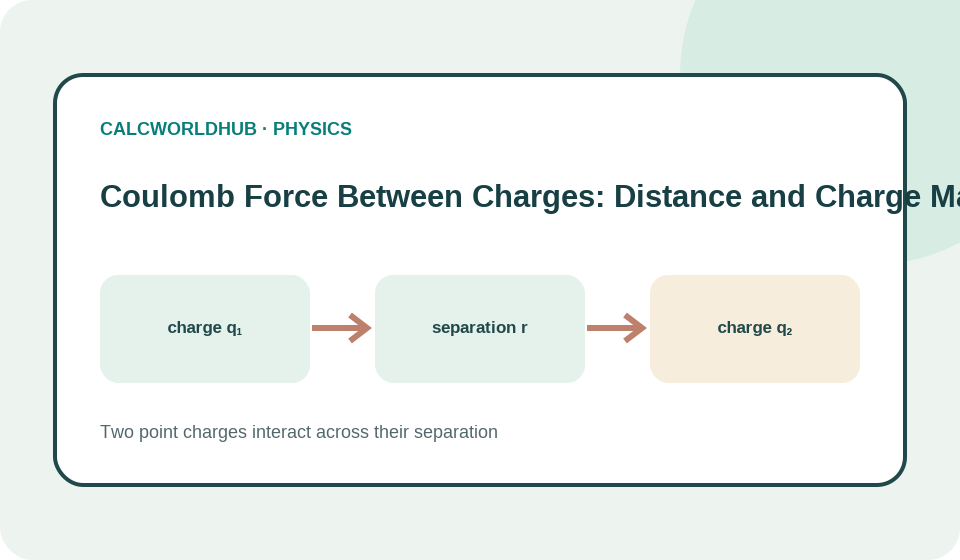
Coulomb force calculator
Find the electrostatic force magnitude between two point charges. Enter your values below to see the result and method.
inputs.
Related calculators
Point-charge field and potential tools describe related electrostatic effects, while this page reports force magnitude.
How to use this calculator
Free Coulomb force calculator. Find the electrostatic force magnitude between two point charges. Formula, example, and assumptions explained.
- Enter Charge 1 (μC), Charge 2 (μC), Separation (m). Match the units shown beside each field and review the result together with the assumptions below.
- Read the worked example below to check the expected input format and result.
- Compare another scenario by changing one input at a time. Use Reset to return to the starting values.
Compare two point charges
Coulomb's inverse-square relation gives force magnitude; the signs of the charges determine whether the force is attractive or repulsive. Find the electrostatic force magnitude between two point charges.
Inputs and units
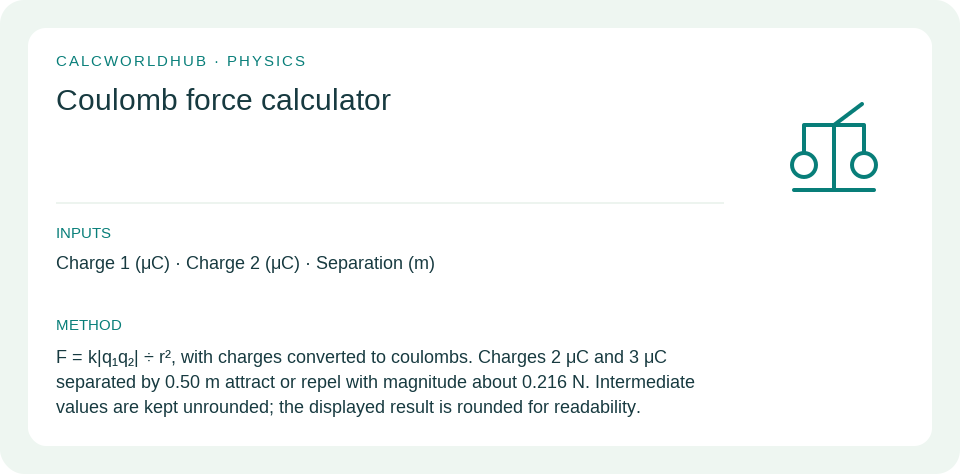
Enter both charges in microcoulombs and separation in meters; output is force magnitude in newtons.
- Charge 1 (μC): First signed point charge in microcoulombs; the output reports force magnitude.
- Charge 2 (μC): Second signed point charge in microcoulombs; equal signs repel and opposite signs attract.
- Separation (m): Positive center-to-center distance between the two point charges, in meters.
Equation and worked example
F = k|q₁q₂| ÷ r², with charges converted to coulombs.
Charges 2 μC and 3 μC separated by 0.50 m attract or repel with magnitude about 0.216 N.
Intermediate values are kept unrounded; the displayed result is rounded for readability.
What the result represents
The result is force magnitude; charge signs determine whether the interaction is attraction or repulsion, which this scalar output does not show.
Assumptions and limitations
Assumes point charges in vacuum or air; sign determines attraction versus repulsion, while this output is magnitude.
Frequently asked questions
What does this Coulomb result report?
It reports the force magnitude k|q₁q₂|/r². The signs of the charges determine whether the force is attractive or repulsive, but are not shown by the magnitude.
Why must charges be converted from microcoulombs?
Coulomb’s constant is in SI units, so each μC input is multiplied by 10⁻⁶ C before calculating force in newtons.
When does the point-charge model apply?
It is an idealization for point charges or bodies small relative to their separation, in a uniform medium approximated as vacuum or air.
How do I use the Coulomb force calculator?
Enter Charge 1 (μC), Charge 2 (μC), Separation (m). Match the units shown beside each field and review the result together with the assumptions below.
What is a worked example of Coulomb force?
F = k|q₁q₂| ÷ r², with charges converted to coulombs. Charges 2 μC and 3 μC separated by 0.50 m attract or repel with magnitude about 0.216 N. Intermediate values are kept unrounded; the displayed result is rounded for readability.
Read the calculation methodology and privacy policy.