How to use this calculator
Calculate crop dry matter as a share of fresh sample mass.
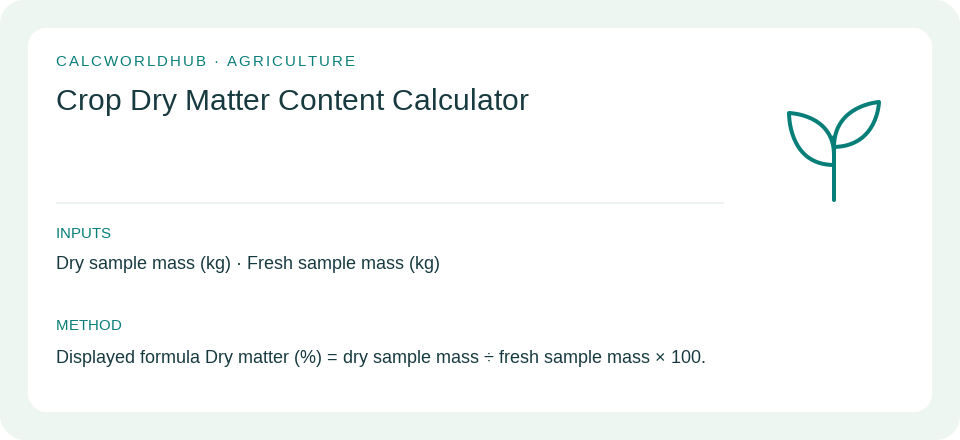
- Enter Dry sample mass (kg), Fresh sample mass (kg). Match the units shown beside each field and review the result together with the assumptions below.
- Read the worked example below to check the expected input format and result.
- Compare another scenario by changing one input at a time. Use Reset to return to the starting values.
How this calculation works
Dry matter content describes how much of a fresh crop sample remains after water is removed by a consistent drying procedure. Moisture content on the same wet basis is its complement.
Inputs and units
dryMassKg— Dry sample mass (kg)- Mass remaining after drying.
freshMassKg— Fresh sample mass (kg)- Mass of the same sample before drying.
Formula
Dry matter (%) = dry sample mass ÷ fresh sample mass × 100.
Method
Weigh the sample fresh, then dry it to a consistent endpoint and weigh again. Use the same mass unit for both values.
Worked example
A crop sample weighing 8 kg fresh and 2 kg after drying contains 25.00% dry matter and 75.00% moisture.
Assumptions and limits
This is a sample-level wet-basis fraction. It does not estimate field yield, storage shrink, or dry matter from a moisture reading unless the sample basis matches.
Frequently asked questions
Can dry mass be greater than fresh mass?
No. For the same sample and mass units, the dried sample cannot weigh more than the fresh sample.
What does the result mean?
The outputs add to 100% because they use the same wet-mass basis.
What should I compare it with?
Compare samples using the same fresh-mass denominator and drying endpoint; this dry-matter percentage is based on fresh sample mass.
How do I use the Crop Dry Matter Content Calculator?
Enter Dry sample mass (kg), Fresh sample mass (kg). Match the units shown beside each field and review the result together with the assumptions below.
What is a worked example of Crop Dry Matter Content?
A crop sample weighing 8 kg fresh and 2 kg after drying contains 25.00% dry matter and 75.00% moisture.
Reference: technical reference. See our calculation methodology.