How to use this calculator
Measure how much eligible inbound freight volume moves directly to outbound loads without putaway.
- Enter Volume transferred directly to outbound loads (m³), Eligible inbound volume (m³). Match the units shown beside each field and review the result together with the assumptions below.
- Read the worked example below to check the expected input format and result.
- Compare another scenario by changing one input at a time. Use Reset to return to the starting values.
How this calculation works
Cross-dock volume share tracks inbound freight transferred to an outbound load without being placed into storage. Use one volume unit and a consistent inbound cohort; the result is an operational share, not a measure of dock throughput or labor productivity.
Inputs and units
crossDockedVolume— Volume transferred directly to outbound loads (m³)- Inbound volume transferred to outbound loads without storage; use the same unit as the denominator.
eligibleInboundVolume— Eligible inbound volume (m³)- Total inbound volume eligible for the same cross-dock measurement cohort.
Formula
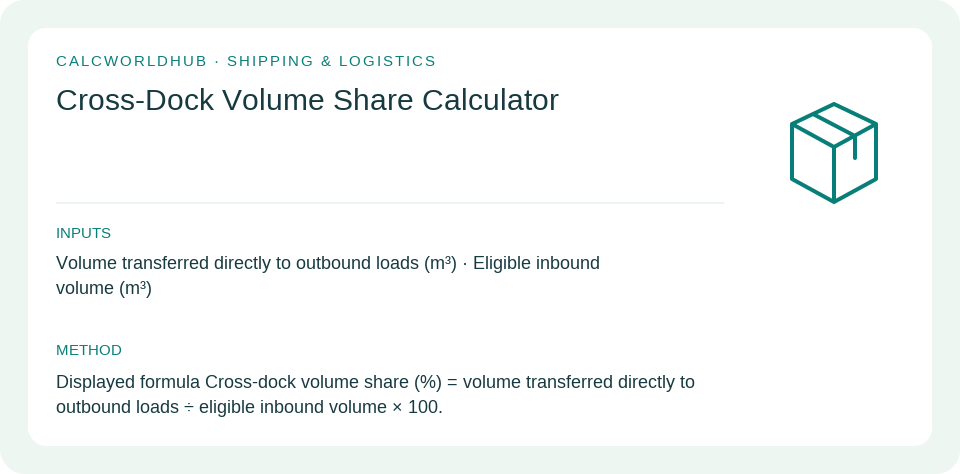
Cross-dock volume share (%) = volume transferred directly to outbound loads ÷ eligible inbound volume × 100.
Method
Count only inbound volume eligible for cross-docking and count each unit once. Keep the cohort window and the definition of eligible volume consistent.
Worked example
Of 10,000 m³ of eligible inbound freight, 7,800 m³ moved directly to outbound loads. The cross-dock volume share is 78.00%, with 2,200 m³ not cross-docked.
Assumptions and limits
The result depends on how eligible freight and transfer volume are defined. It does not measure handling cost, service level, or dwell time.
Frequently asked questions
What counts as cross-docked volume?
Volume transferred from an inbound load to an outbound load without first being put away into storage.
How should volume be measured?
Use one consistent volume method for both values, such as measured freight cube.
Does this measure cross-dock productivity?
No. It is a volume share and does not account for labor, time, or service outcomes.
How do I use the Cross-Dock Volume Share Calculator?
Enter Volume transferred directly to outbound loads (m³), Eligible inbound volume (m³). Match the units shown beside each field and review the result together with the assumptions below.
What is a worked example of Cross-Dock Volume Share?
Of 10,000 m³ of eligible inbound freight, 7,800 m³ moved directly to outbound loads. The cross-dock volume share is 78.00%, with 2,200 m³ not cross-docked.
Read our calculation methodology.