How to use this calculator
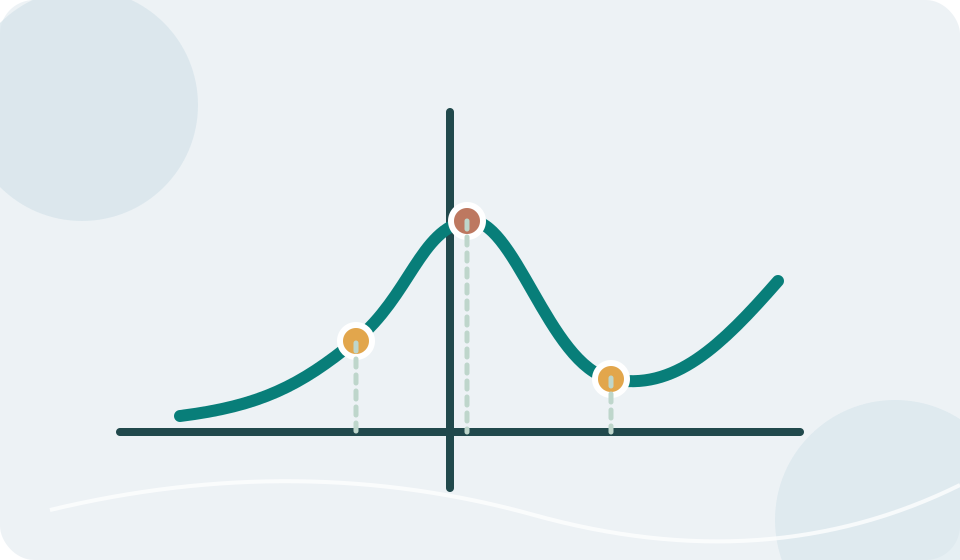
Find distinct real solutions of a cubic equation and distinguish one-real-root and three-real-root cases.
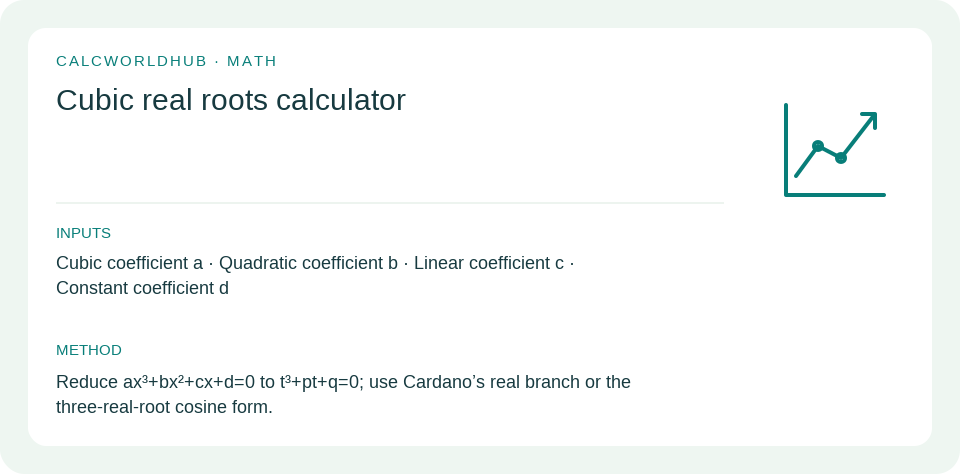
- Enter Cubic coefficient a, Quadratic coefficient b, Linear coefficient c, Constant coefficient d. Match the units shown beside each field and review the result together with the assumptions below.
- Read the worked example below to check the expected input format and result.
- Compare another scenario by changing one input at a time. Use Reset to return to the starting values.
Cubic real roots explained
Find distinct real roots of a supplied cubic using the real Cardano or three-real-root branch.
Example with entered values
Cubic coefficient a = 1; Quadratic coefficient b = -6; Linear coefficient c = 11; Constant coefficient d = -6.
- Distinct real roots: 3 roots
- Root values: 1, 2, 3
The polynomial factors as (x − 1)(x − 2)(x − 3), so the three distinct real roots are 1, 2, and 3.
The calculation behind the result
Reduce ax³+bx²+cx+d=0 to t³+pt+q=0; use Cardano’s real branch or the three-real-root cosine form.
Inputs and units
- Cubic coefficient a
- Coefficient of x³, nonzero.
- Quadratic coefficient b
- Coefficient of x².
- Linear coefficient c
- Coefficient of x.
- Constant coefficient d
- Constant term.
Before interpreting the result
Floating-point tolerances merge nearly equal roots. Ill-conditioned coefficients and nearly repeated roots can reduce numerical accuracy.
The quadratic solver covers degree two. This page requires a genuine degree-three coefficient and does not display complex roots.
Frequently asked questions
Why are complex roots omitted?
This version is explicitly a real-root solver.
How are repeated roots counted?
They appear once in the distinct-root list.
Can a cubic have no real roots?
A real-coefficient genuine cubic has at least one real root.
How do I use the Cubic real roots calculator?
Enter Cubic coefficient a, Quadratic coefficient b, Linear coefficient c, Constant coefficient d. Match the units shown beside each field and review the result together with the assumptions below.
What is a worked example of Cubic real roots?
Cubic coefficient a = 1; Quadratic coefficient b = -6; Linear coefficient c = 11; Constant coefficient d = -6. Distinct real roots: 3 roots Root values: 1, 2, 3 The polynomial factors as (x − 1)(x − 2)(x − 3), so the three distinct real roots are 1, 2, and 3.
See our calculation methodology.