How to use this calculator
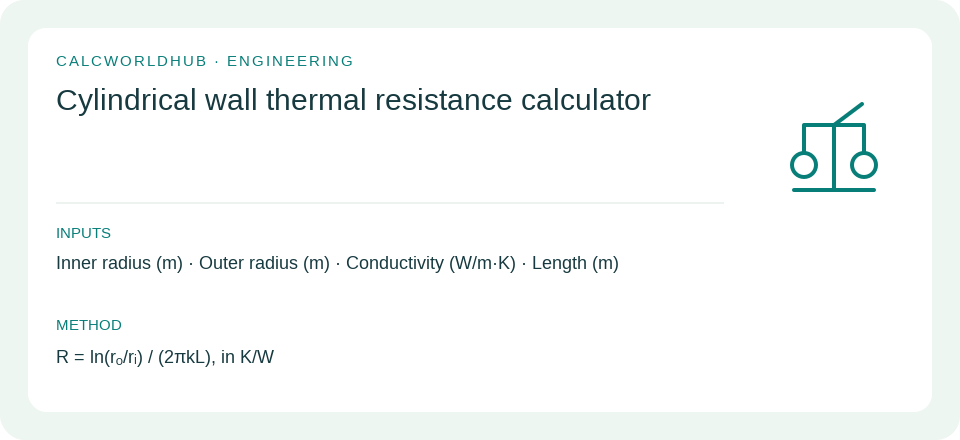
Calculate steady radial conduction resistance through a hollow cylindrical wall from radii, conductivity, and axial length.
- Enter Inner radius (m), Outer radius (m), Conductivity (W/m·K), Length (m). Match the units shown beside each field and review the result together with the assumptions below.
- Read the worked example below to check the expected input format and result.
- Compare another scenario by changing one input at a time. Use Reset to return to the starting values.
How Cylindrical wall thermal resistance calculator works
Calculate steady radial conduction resistance through a hollow cylindrical wall from radii, conductivity, and axial length.
Inputs and units
- Inner radius (m): Enter the inner radius in meters; it must be positive and smaller than the outer radius.
- Outer radius (m): Enter the outer radius in meters, greater than the inner radius.
- Conductivity (W/m·K): Enter positive thermal conductivity in W/(m·K).
- Length (m): Enter positive cylinder length in meters.
Formula and method
R = ln(rₒ/rᵢ) / (2πkL), in K/W
Worked example
For rᵢ = 0.05 m, rₒ = 0.10 m, k = 0.8 W/(m·K), and L = 2 m, R = ln(2)/(2π·0.8·2) ≈ 0.06895 K/W.
Interpreting the result
For steady one-dimensional radial conduction, temperature difference equals heat rate times this resistance. Doubling length or conductivity halves R.
Assumptions and limits
Assumes steady radial conduction, constant isotropic conductivity, no contact resistance, and negligible end effects. Layered walls require adding each layer's cylindrical resistance; convection films are separate resistances.
Sources and method
- Logarithmic radial resistance for a cylindrical wall. MIT OpenCourseWare: conduction
Frequently asked questions
Why does the formula use a logarithm of the radii?
Radial heat-flow area grows with radius, so integrating the conduction resistance through the wall gives a logarithmic ratio.
Is this the total resistance of an insulated pipe?
Only for the wall material represented by these inputs; surface convection and contact resistances are not included.
How do I use the Cylindrical wall thermal resistance calculator?
Enter Inner radius (m), Outer radius (m), Conductivity (W/m·K), Length (m). Match the units shown beside each field and review the result together with the assumptions below.
What is a worked example of Cylindrical wall thermal resistance?
For rᵢ = 0.05 m, rₒ = 0.10 m, k = 0.8 W/(m·K), and L = 2 m, R = ln(2)/(2π·0.8·2) ≈ 0.06895 K/W.
What does the Cylindrical wall thermal resistance calculator calculate?
Calculate steady radial conduction resistance through a hollow cylindrical wall from radii, conductivity, and axial length.