How to use this calculator
Compute one regularized two-parameter least-squares correction from residuals and their Jacobian.
- Enter Jacobian row-major, Current residuals, Damping parameter. Match the units shown beside each field and review the result together with the assumptions below.
- Read the worked example below to check the expected input format and result.
- Compare another scenario by changing one input at a time. Use Reset to return to the starting values.
Damped Gauss Newton residual step explained
Compute one regularized two-parameter least-squares correction from residuals and their Jacobian.
How the calculation works
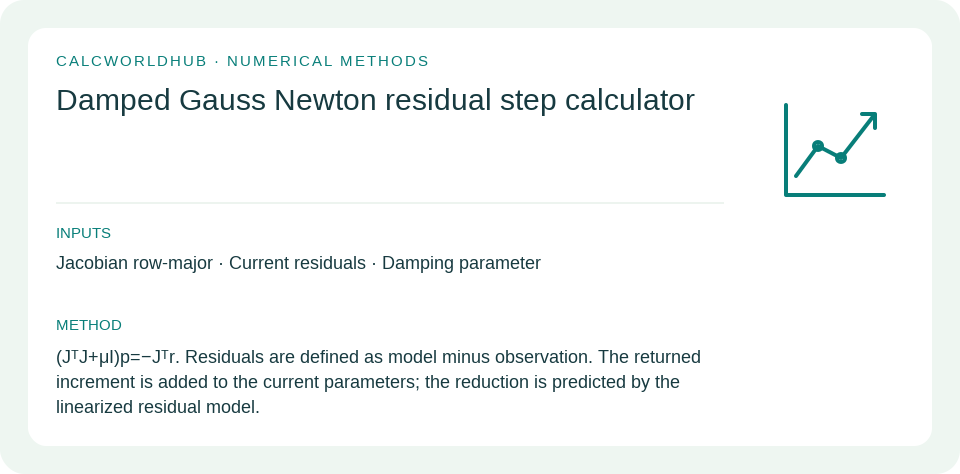
(JᵀJ+μI)p=−Jᵀr.
Residuals are defined as model minus observation. The returned increment is added to the current parameters; the reduction is predicted by the linearized residual model.
Set up the calculation
jacobian— Jacobian row-major- Two columns, one row per residual. Use comma-separated values in the stated order.
residual— Current residuals- Residuals matching Jacobian rows. Use comma-separated values in the stated order.
damping— Damping parameter- Nonnegative diagonal regularization added to J transpose J.
Limits of this model
Only a local linear model is used; evaluate the original nonlinear residuals before accepting a step. Parameters should be scaled consistently.
Check this example
Jacobian row-major = [1, 0, 1, 1, 1, 2]; Current residuals = [1, -1, 0.5]; Damping parameter = 0.1.
- First parameter increment: -0.374449 parameter units
- Second parameter increment: 0.220264 parameter units
- Linearized squared residual reduction: 0.206098 residual squared
The three residuals 1, −1 and 0.5 with damping 0.1 produce a finite correction even when nonlinear fitting has not converged.
Reading the outputs
Both parameter increments and the predicted reduction in squared residual norm are returned.
Frequently asked questions
Do I add or subtract the increment?
Add it; the negative gradient sign is included.
Does positive predicted reduction guarantee improvement?
No. The nonlinear function may depart from its local linearization.
Why add damping?
It limits poorly determined directions and can regularize rank-deficient Jacobians.
How do I use the Damped Gauss Newton residual step calculator?
Enter Jacobian row-major, Current residuals, Damping parameter. Match the units shown beside each field and review the result together with the assumptions below.
What is a worked example of Damped Gauss Newton residual step?
Jacobian row-major = [1, 0, 1, 1, 1, 2]; Current residuals = [1, -1, 0.5]; Damping parameter = 0.1. First parameter increment: -0.374449 parameter units Second parameter increment: 0.220264 parameter units Linearized squared residual reduction: 0.206098 residual squared The three residuals 1, −1 and 0.5 with damping 0.1 produce a finite correction even when nonlinear fitting has not converged.
Background or definition reference: Boyd and Vandenberghe Convex Optimization.
Read our calculation methodology.