How to use this calculator
Solve the free displacement and velocity after a specified initial disturbance for underdamped, critical, or overdamped motion.
- Enter Mass (kg), Stiffness (N/m), Viscous damping (N s/m), Initial displacement (m), then complete the remaining labeled fields. Match the units shown beside each field and review the result together with the assumptions below.
- Read the worked example below to check the expected input format and result.
- Compare another scenario by changing one input at a time. Use Reset to return to the starting values.
Damped oscillator initial value response explained
Evaluate displacement and velocity at a requested time for the entered underdamped mass–spring initial-value model.
How the calculation works
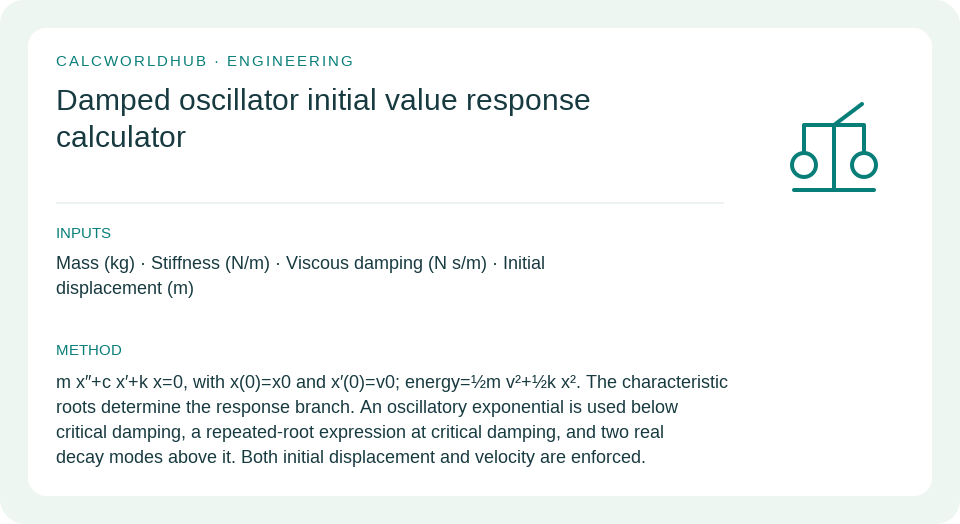
m x″+c x′+k x=0, with x(0)=x0 and x′(0)=v0; energy=½m v²+½k x².
The characteristic roots determine the response branch. An oscillatory exponential is used below critical damping, a repeated-root expression at critical damping, and two real decay modes above it. Both initial displacement and velocity are enforced.
Inputs and units
m— Mass (kg)- Mass in kilograms.
k— Stiffness (N/m)- Linear force per displacement in newtons per metre.
c— Viscous damping (N s/m)- Viscous force coefficient in newton-seconds per metre.
x0— Initial displacement (m)- Signed displacement from equilibrium at elapsed time zero, in metres.
v0— Initial velocity (m/s)- Signed initial velocity along the same displacement axis, in metres per second.
t— Elapsed time (s)- Time in seconds.
Limits of this model
Constant positive mass and stiffness with nonnegative viscous damping. The near-critical numerical branch uses a relative discriminant tolerance. There is no external force or support movement.
Check this example
Mass (kg) = 5; Stiffness (N/m) = 800; Viscous damping (N s/m) = 25; Initial displacement (m) = 0.03; Initial velocity (m/s) = -0.1; Elapsed time (s) = 0.4.
- Displacement at query time: 0.003422289 m
- Velocity at query time: 0.12187002 m/s
- Damping regime: Underdamped
- Mechanical energy: 0.04181558 J
The mass begins thirty millimetres from equilibrium and is already moving back at 0.1 m/s. A displacement envelope alone cannot determine its position at 0.4 seconds.
Reading the outputs
Velocity retains its sign. Mechanical energy excludes dissipated heat and should not increase over time in this passive model.
Frequently asked questions
Can damping be zero?
Yes. The solution becomes undamped harmonic motion.
Does this include a continuing sinusoidal load?
No. Use harmonic forced response for a steady applied excitation.
Can displacement change sign?
Yes. Underdamped motion can pass through equilibrium even while its amplitude envelope decays.
How do I use the Damped oscillator initial value response calculator?
Enter Mass (kg), Stiffness (N/m), Viscous damping (N s/m), Initial displacement (m), then complete the remaining labeled fields. Match the units shown beside each field and review the result together with the assumptions below.
What is a worked example of Damped oscillator initial value response?
Mass (kg) = 5; Stiffness (N/m) = 800; Viscous damping (N s/m) = 25; Initial displacement (m) = 0.03; Initial velocity (m/s) = -0.1; Elapsed time (s) = 0.4. Displacement at query time: 0.003422289 m Velocity at query time: 0.12187002 m/s Damping regime: Underdamped Mechanical energy: 0.04181558 J The mass begins thirty millimetres from equilibrium and is already moving back at 0.1 m/s. A displacement envelope alone cannot determine its position at 0.4 seconds.
Sources
Background or definition reference: OpenStax forced oscillation model.
Read our calculation methodology.