How to use this calculator
Estimate payoff time and interest when you pay minimums on three debts and direct extra money to the highest APR first.
- Enter Debt A balance ($), Debt A nominal APR (%), Debt A minimum payment per month ($), Debt B balance ($), then complete the remaining labeled fields. Match the units shown beside each field and review the result together with the assumptions below.
- Read the worked example below to check the expected input format and result.
- Compare another scenario by changing one input at a time. Use Reset to return to the starting values.
How this calculation works
The avalanche approach prioritizes the highest-rate balance while keeping payments on the others. This month-by-month estimate applies interest at each entered nominal APR divided by 12, pays the stated minimums, and sends any remaining fixed monthly budget to balances in descending APR order.
Inputs and units
balanceA— Debt A balance ($)- Current amount owed on the first debt.
aprA— Debt A nominal APR (%)- Annual percentage rate for Debt A, entered as a percentage.
minimumA— Debt A minimum payment per month ($)- Fixed monthly minimum assumed for Debt A while it remains open.
balanceB— Debt B balance ($)- Current amount owed on the second debt.
aprB— Debt B nominal APR (%)- Annual percentage rate for Debt B.
minimumB— Debt B minimum payment per month ($)- Fixed monthly minimum assumed for Debt B while it remains open.
balanceC— Debt C balance ($)- Current amount owed on the third debt.
aprC— Debt C nominal APR (%)- Annual percentage rate for Debt C.
minimumC— Debt C minimum payment per month ($)- Fixed monthly minimum assumed for Debt C while it remains open.
extraMonthly— Extra amount available per month ($)- Additional fixed monthly payment, directed to the highest-rate active debt.
Formula
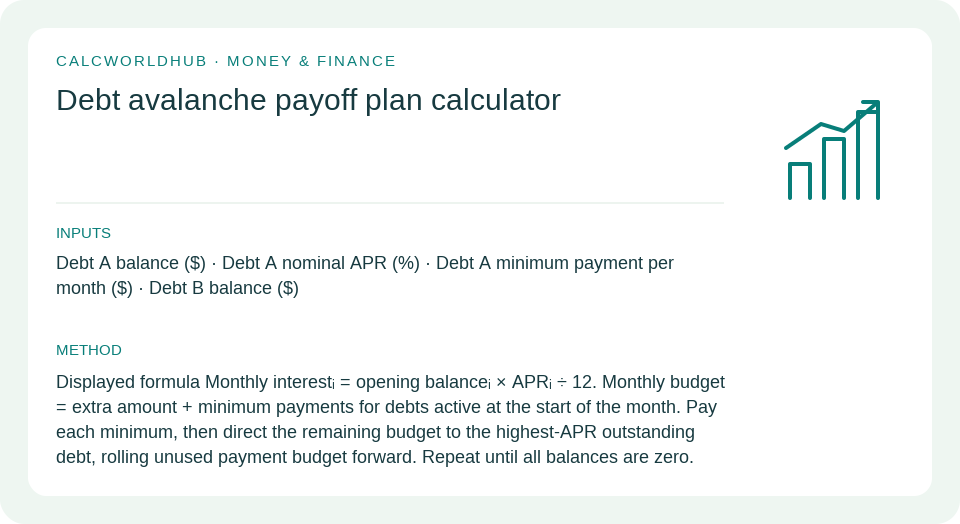
Monthly interestᵢ = opening balanceᵢ × APRᵢ ÷ 12. Monthly budget = extra amount + minimum payments for debts active at the start of the month. Pay each minimum, then direct the remaining budget to the highest-APR outstanding debt, rolling unused payment budget forward. Repeat until all balances are zero.
Method
Enter three balances, their nominal annual rates, each minimum monthly payment, and a fixed extra monthly amount. The model charges monthly interest before payments, pays minimums first, then applies the remaining budget by highest APR. It reports the resulting order, months, interest, and total paid.
Worked example
With Debt A at $3,000 and 24% APR, Debt B at $5,000 and 18%, Debt C at $1,200 and 9%, the entered minimums of $100, $150, and $40 plus $100 extra are simulated monthly. The highest-rate payoff order is A → B → C. The schedule takes 34 months, with $2,354.16 total interest and $11,554.16 total payments.
Assumptions and limits
This is a simplified fixed-rate monthly model. Real card issuers may accrue daily interest, change minimums, apply payment-allocation rules, charge fees, or add purchases. The estimate assumes no new charges, constant APRs, and stable minimum amounts; compare the result with creditor statements and terms.
Frequently asked questions
How does the debt avalanche order balances?
It pays the minimum on each open debt and directs the remaining monthly budget to the balance with the highest APR, then moves to the next rate after payoff.
Is this the same as the debt snowball method?
No. Avalanche ranks by interest rate; snowball ranks by balance size. Both require minimum payments on all debts, but their payoff order differs.
Why can my statement show a different payoff date?
This model uses monthly APR/12 interest and fixed minimums. Issuers can use daily accrual, changing minimums, fees, and payment allocation rules.
How do I use the Debt avalanche payoff plan calculator?
Enter Debt A balance ($), Debt A nominal APR (%), Debt A minimum payment per month ($), Debt B balance ($), then complete the remaining labeled fields. Match the units shown beside each field and review the result together with the assumptions below.
What is a worked example of Debt avalanche payoff plan?
With Debt A at $3,000 and 24% APR, Debt B at $5,000 and 18%, Debt C at $1,200 and 9%, the entered minimums of $100, $150, and $40 plus $100 extra are simulated monthly. The highest-rate payoff order is A → B → C. The schedule takes 34 months, with $2,354.16 total interest and $11,554.16 total payments.
Reference: Chase debt avalanche overview. See our calculation methodology.