How to use this calculator
Divide observed defect occurrences by inspected units while allowing several defects on one unit.
- Enter Total observed defects, Units inspected. Match the units shown beside each field and review the result together with the assumptions below.
- Read the worked example below to check the expected input format and result.
- Compare another scenario by changing one input at a time. Use Reset to return to the starting values.
Defects per unit explained
Defects per unit is the total number of defects divided by the number of inspected units. A unit can contain several defects, so this average is not the same as the percentage of units with at least one defect.
How the calculation works
d/u
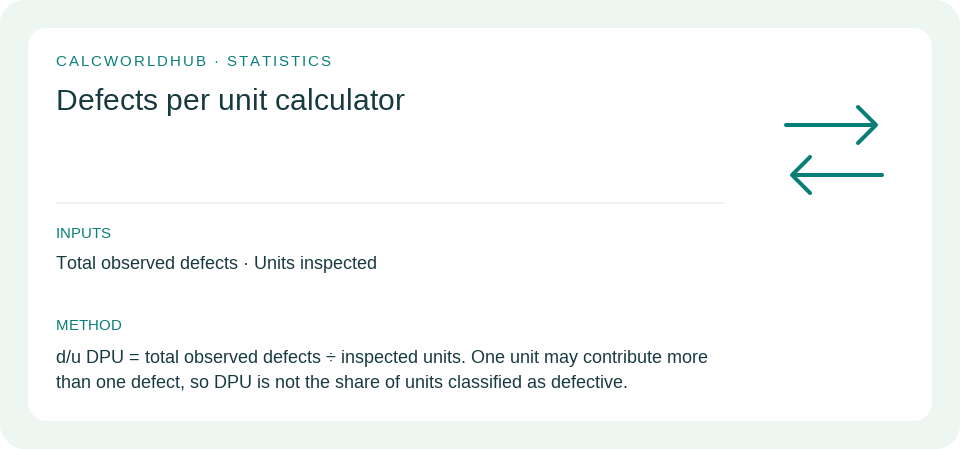
DPU = total observed defects ÷ inspected units. One unit may contribute more than one defect, so DPU is not the share of units classified as defective.
Set up the calculation
d— Total observed defects- Total observed defects. Enter a whole number.
u— Units inspected- Units inspected. Enter a whole number.
Limits of this model
A defect count is not a defective-unit count. Inspection coverage and the definition of a defect must remain consistent.
Check this example
Total observed defects = 12; Units inspected = 5000.
- Defects per unit: 0.0024 defects/unit
This scenario uses the stated units and assumptions. Displayed values are rounded only after calculation.
Frequently asked questions
Can DPU exceed one?
Yes, a unit may contain multiple defects.
Is DPU the same as defect probability?
No, it is an average defect count per unit.
How does DPMO differ?
DPMO also divides by defined defect opportunities per unit.
How do I use the Defects per unit calculator?
Enter Total observed defects, Units inspected. Match the units shown beside each field and review the result together with the assumptions below.
What is a worked example of Defects per unit?
Total observed defects = 12; Units inspected = 5000. Defects per unit: 0.0024 defects/unit This scenario uses the stated units and assumptions. Displayed values are rounded only after calculation.
Read our calculation methodology.