How to use this calculator
Fit a straight line while allowing measurement error in both methods through a specified variance ratio.
- Enter First method x measurements, Second method y measurements, Measurement error variance ratio σy²/σx². Match the units shown beside each field and review the result together with the assumptions below.
- Read the worked example below to check the expected input format and result.
- Compare another scenario by changing one input at a time. Use Reset to return to the starting values.
Deming errors in variables regression explained
The paired measurements are fit with the entered ratio of y-error variance to x-error variance.
A numerical walkthrough
First method x measurements = 1, 2, 3, 4; Second method y measurements = 1.1, 2, 3.2, 3.9; Measurement error variance ratio σy²/σx² = 1.
- Deming slope: 0.96420605
- Intercept: 0.13948487 y units
With equal x- and y-measurement error variances (δ = 1), the fitted Deming line has slope 0.9642 and intercept 0.1395. The fit accounts for error in both methods; it does not by itself establish practical agreement.
The model behind the numbers
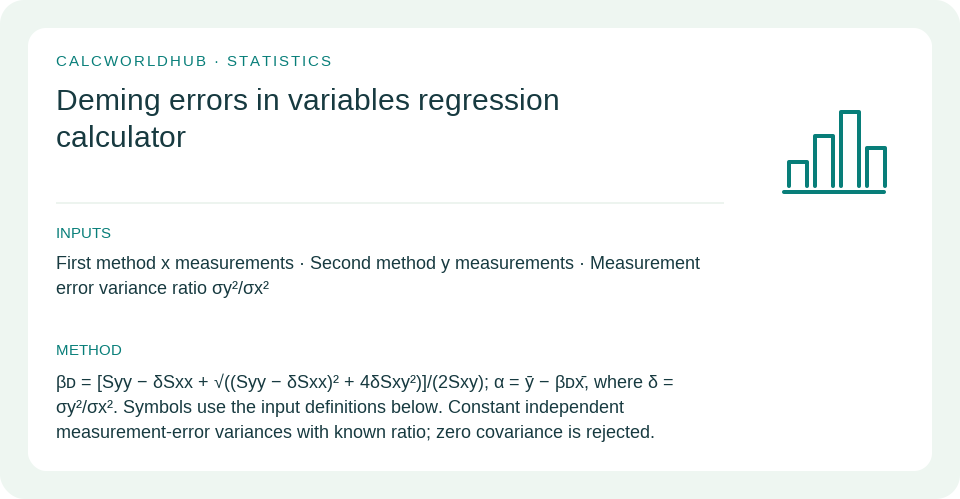
βᴅ = [Syy − δSxx + √((Syy − δSxx)² + 4δSxy²)]/(2Sxy); α = ȳ − βᴅx̄, where δ = σy²/σx².
Symbols use the input definitions below. Constant independent measurement-error variances with known ratio; zero covariance is rejected.
What to enter
x— First method x measurements- First method's x measurements, paired by position with the y list; both lists need the same number of values.
y— Second method y measurements- Second method's y measurements, paired in the same order as x; units may differ between methods.
d— Measurement error variance ratio σy²/σx²- Known or externally estimated measurement-error variance in y divided by that in x; it is not the ratio of total sample variances.
Interpreting the result
Constant independent measurement-error variances with known ratio; zero covariance is rejected. This is not ordinary least squares.
Frequently asked questions
What ratio should be entered?
Variance of y measurement error divided by variance of x measurement error.
Can I infer the ratio from total sample variances?
Not generally; total variation includes the underlying signal.
Does the fit establish interchangeability?
No, assess differences and practical agreement separately.
How do I use the Deming errors in variables regression calculator?
Enter First method x measurements, Second method y measurements, Measurement error variance ratio σy²/σx². Match the units shown beside each field and review the result together with the assumptions below.
What is a worked example of Deming errors in variables regression?
First method x measurements = 1, 2, 3, 4; Second method y measurements = 1.1, 2, 3.2, 3.9; Measurement error variance ratio σy²/σx² = 1. Deming slope: 0.96420605 Intercept: 0.13948487 y units With equal x- and y-measurement error variances (δ = 1), the fitted Deming line has slope 0.9642 and intercept 0.1395. The fit accounts for error in both methods; it does not by itself establish practical agreement.
Method reference: NIST Deming regression.
Read our calculation methodology.