How to use this calculator
Estimate the lifetime and shrinking diameter of an isolated droplet under dilute, diffusion-controlled evaporation.
- Enter Initial spherical droplet diameter (m), Vapor diffusivity in surrounding gas (m²/s), Equilibrium vapor mass concentration at surface (kg/m³), Far-field vapor mass concentration (kg/m³), then complete the remaining labeled fields. Match the units shown beside each field and review the result together with the assumptions below.
- Read the worked example below to check the expected input format and result.
- Compare another scenario by changing one input at a time. Use Reset to return to the starting values.
Diffusion controlled droplet evaporation d squared lifetime explained
A numerical walkthrough
Initial spherical droplet diameter (m) = 0.001; Vapor diffusivity in surrounding gas (m²/s) = 0.000025; Equilibrium vapor mass concentration at surface (kg/m³) = 0.023; Far-field vapor mass concentration (kg/m³) = 0.01; Liquid density (kg/m³) = 998; Time after initial state (s) = 10; Latent evaporation heat (J/kg) = 2450000.
- Ideal complete evaporation lifetime: 383.846154 s
- Remaining diameter at selected time: 0.000987 m
- Initial evaporation mass rate: 2.04203522e-09 kg/s
- Initial latent-heat supply required: 0.005003 W
A 1 mm droplet of density 998 kg/m³ evaporates into quiescent gas with diffusivity 2.5e−5 m²/s and vapor concentration difference 0.013 kg/m³. Its ideal lifetime is 383.846 s; after 10 s its diameter is 0.986888 mm, provided about 5.003 mW initial latent heat can be supplied.
The model behind the numbers
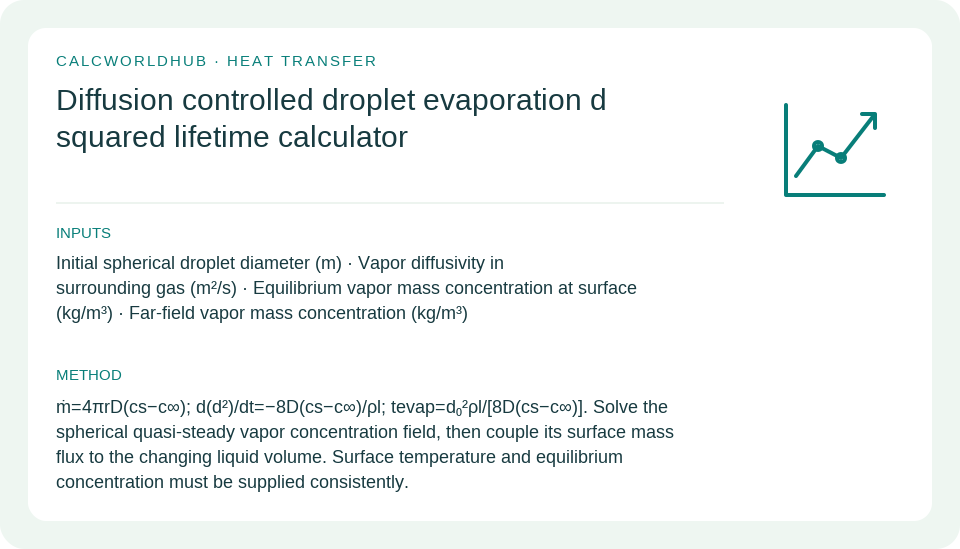
ṁ=4πrD(cs−c∞); d(d²)/dt=−8D(cs−c∞)/ρl; tevap=d₀²ρl/[8D(cs−c∞)].
Solve the spherical quasi-steady vapor concentration field, then couple its surface mass flux to the changing liquid volume. Surface temperature and equilibrium concentration must be supplied consistently.
What to enter
d— Initial spherical droplet diameter (m)- Initial spherical droplet diameter (m). Enter the value for this state; the units shown are used without an unstated conversion.
D— Vapor diffusivity in surrounding gas (m²/s)- Vapor diffusivity in surrounding gas (m²/s). Enter the value for this state; the units shown are used without an unstated conversion.
cs— Equilibrium vapor mass concentration at surface (kg/m³)- Equilibrium vapor mass concentration at surface (kg/m³). Enter the value for this state; the units shown are used without an unstated conversion.
ci— Far-field vapor mass concentration (kg/m³)- Far-field vapor mass concentration (kg/m³). Enter the value for this state; the units shown are used without an unstated conversion.
rho— Liquid density (kg/m³)- Liquid density (kg/m³). Enter the value for this state; the units shown are used without an unstated conversion.
t— Time after initial state (s)- Time after initial state (s). Enter the value for this state; the units shown are used without an unstated conversion.
latent— Latent evaporation heat (J/kg)- Latent evaporation heat (J/kg). Enter the value for this state; the units shown are used without an unstated conversion.
Interpreting the result
Dilute vapor in quiescent gas, no Stefan-flow correction, convection, droplet interactions or temperature evolution. Assumes sufficient heat supply to hold surface concentration fixed; diameter becomes zero after the ideal lifetime.
Reading the outputs
Lifetime is s, remaining diameter is m and initial mass rate is kg/s. Required latent heat is W and must be supplied to maintain the assumed surface state.
Frequently asked questions
Why does diameter squared decrease linearly?
Diffusive mass loss scales with radius, while liquid inventory scales with radius cubed.
Does this determine droplet surface temperature?
No. Evaporative cooling needs a coupled heat balance; the supplied surface concentration fixes that state here.
Can it model a spray in a fast airflow?
Not directly. Forced convection, interaction and non-dilute vapor change the transport rate.
How do I use the Diffusion controlled droplet evaporation d squared lifetime calculator?
Enter Initial spherical droplet diameter (m), Vapor diffusivity in surrounding gas (m²/s), Equilibrium vapor mass concentration at surface (kg/m³), Far-field vapor mass concentration (kg/m³), then complete the remaining labeled fields. Match the units shown beside each field and review the result together with the assumptions below.
What is a worked example of Diffusion controlled droplet evaporation d squared lifetime?
Initial spherical droplet diameter (m) = 0.001; Vapor diffusivity in surrounding gas (m²/s) = 0.000025; Equilibrium vapor mass concentration at surface (kg/m³) = 0.023; Far-field vapor mass concentration (kg/m³) = 0.01; Liquid density (kg/m³) = 998; Time after initial state (s) = 10; Latent evaporation heat (J/kg) = 2450000. Ideal complete evaporation lifetime: 383.846154 s Remaining diameter at selected time: 0.000987 m Initial evaporation mass rate: 2.04203522e-09 kg/s Initial latent-heat supply required: 0.005003 W A 1 mm droplet of density 998 kg/m³ evaporates into quiescent gas with diffusivity 2.5e−5 m²/s and vapor concentration difference 0.013 kg/m³.
Read our calculation methodology.