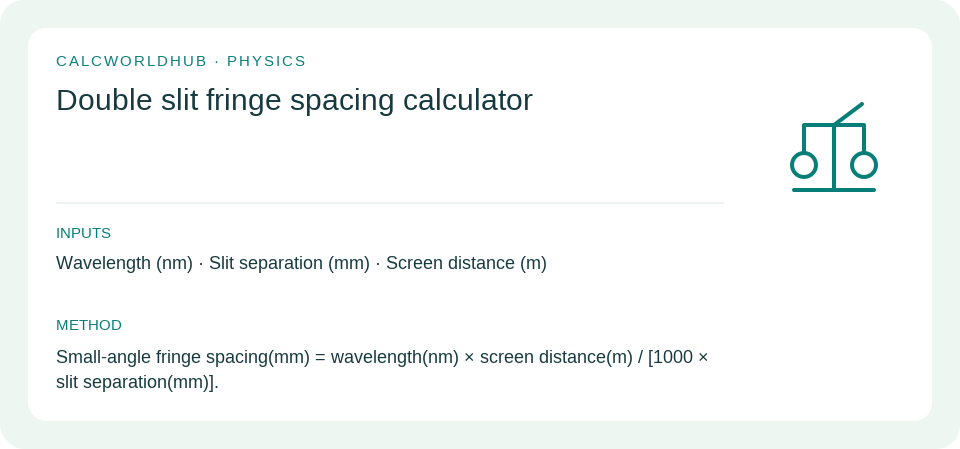
How to use this calculator
Estimate adjacent bright-fringe spacing for a Young double-slit experiment using the small-angle approximation.
- Enter Wavelength (nm), Slit separation (mm), Screen distance (m). Match the units shown beside each field and review the result together with the assumptions below.
- Read the worked example below to check the expected input format and result.
- Compare another scenario by changing one input at a time. Use Reset to return to the starting values.
Double slit fringe spacing explained
For 633 nm light crossing a 0.3 mm slit separation, the paraxial fringe spacing at a 1.5 m screen is 3.165 mm. It scales with wavelength and screen distance and inversely with slit separation.
How the calculation works
Small-angle fringe spacing(mm) = wavelength(nm) × screen distance(m) / [1000 × slit separation(mm)].
Inputs and units
- Wavelength (nm)
- Monochromatic light wavelength.
- Slit separation (mm)
- Center-to-center distance between the slits.
- Screen distance (m)
- Distance from slits to screen.
Limits of this model
Requires coherent light and a far screen with small fringe angles. Slit width affects the envelope but is not entered here.
Single-slit diffraction calculates the envelope minimum. This tool estimates the fine interference spacing between two slits.
Check a numerical scenario
Wavelength (nm) = 633; Slit separation (mm) = 0.3; Screen distance (m) = 1.5.
- Paraxial fringe spacing: 3.165 mm
The 3.165 mm result uses λL/d in the small-angle regime; it is tiny relative to the 1.5 m screen distance. At larger angles, use the exact geometry rather than treating every fringe interval as constant.
Frequently asked questions
Is this exact at large angles?
No. The screen geometry and sine condition require an exact treatment.
Does slit width affect spacing?
Separation sets this spacing; individual slit width shapes the envelope.
Does larger separation spread fringes apart?
No. It decreases the spacing.
How do I use the Double slit fringe spacing calculator?
Enter Wavelength (nm), Slit separation (mm), Screen distance (m). Match the units shown beside each field and review the result together with the assumptions below.
What is a worked example of Double slit fringe spacing?
Wavelength (nm) = 633; Slit separation (mm) = 0.3; Screen distance (m) = 1.5. Paraxial fringe spacing: 3.165 mm The 3.165 mm result uses λL/d in the small-angle regime; it is tiny relative to the 1.5 m screen distance. At larger angles, use the exact geometry rather than treating every fringe interval as constant.
Method reference: OpenStax Young double-slit interference (checked October 15, 2026).
See our calculation methodology.