How to use this calculator
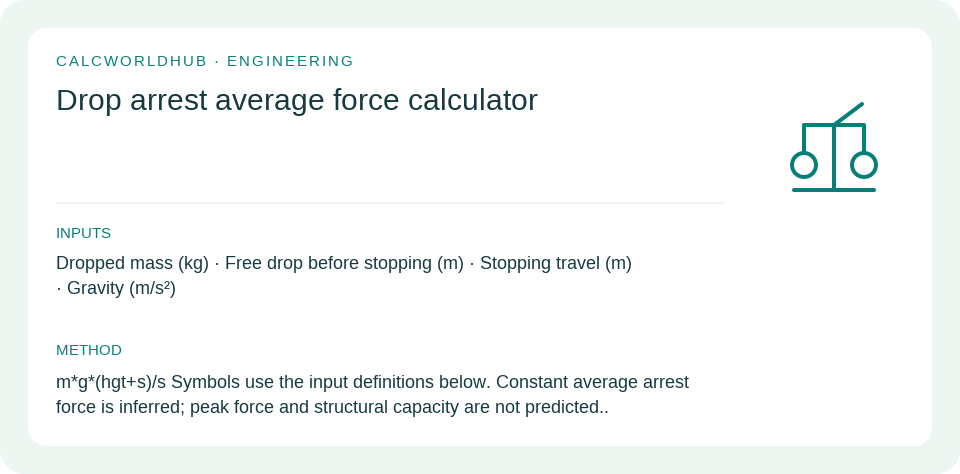
Use energy balance to estimate average upward stopping force after a vertical free fall.
- Enter Dropped mass (kg), Free drop before stopping (m), Stopping travel (m), Gravity (m/s²). Match the units shown beside each field and review the result together with the assumptions below.
- Read the worked example below to check the expected input format and result.
- Compare another scenario by changing one input at a time. Use Reset to return to the starting values.
Drop arrest average force explained
Use Dropped mass (kg) with Free drop before stopping (m) to reproduce the sample calculation, then review the stated limits before carrying the result into another scenario.
Inputs, symbols, and units
m— Dropped mass (kg)- Dropped mass (kg).
hgt— Free drop before stopping (m)- Free drop before stopping (m).
s— Stopping travel (m)- Stopping travel (m).
g— Gravity (m/s²)- Gravity (m/s²).
Inputs and units
- Dropped mass (kg)
- Free drop before stopping (m)
- Stopping travel (m)
- Gravity (m/s²)
Formula and method
m*g*(hgt+s)/s
Symbols use the input definitions below. Constant average arrest force is inferred; peak force and structural capacity are not predicted..
A worked scenario
Dropped mass (kg) = 10; Free drop before stopping (m) = 1; Stopping travel (m) = 0.05; Gravity (m/s²) = 9.80665.
- Drop arrest average force: 2059.3965 N
This scenario uses the stated units and assumptions. Displayed values are rounded only after calculation.
Assumptions and edge cases
Constant average arrest force is inferred; peak force and structural capacity are not predicted.
Sources and method notes
- The work-energy example relates fall height and stopping distance to average stopping force; it also shows why short stopping distance can create large force. OpenStax College Physics: work and gravitational potential energy
- OSHA discusses free-fall and deceleration distances, equipment instructions, clearance, and the need to select a system for the work situation. OSHA: personal fall-arrest system guidance
Frequently asked questions
Is this peak force?
No.
Why add stopping travel to drop height?
Gravity continues doing work during stopping.
Does damping shape matter?
It changes peak force, absent here.
How do I use the Drop arrest average force calculator?
Enter Dropped mass (kg), Free drop before stopping (m), Stopping travel (m), Gravity (m/s²). Match the units shown beside each field and review the result together with the assumptions below.
What is a worked example of Drop arrest average force?
Dropped mass (kg) = 10; Free drop before stopping (m) = 1; Stopping travel (m) = 0.05; Gravity (m/s²) = 9.80665. Drop arrest average force: 2059.3965 N This scenario uses the stated units and assumptions. Displayed values are rounded only after calculation.
Read our calculation methodology.