How to use this calculator
Compare mean pooled ranks between independent groups using tie-corrected Dunn z statistics and Holm-adjusted pairwise p-values.
- Enter Observed values, Integer group labels. Match the units shown beside each field and review the result together with the assumptions below.
- Read the worked example below to check the expected input format and result.
- Compare another scenario by changing one input at a time. Use Reset to return to the starting values.
Dunn pairwise rank comparisons with Holm correction explained
Dunn’s post-hoc procedure compares mean ranks for each pair of groups. The Holm step-down adjustment then accounts for testing several pairs while controlling family-wise error.
Inputs, symbols, and units
x— Observed values- Ordered values in the role named above. Match row positions with other lists and use a consistent measurement unit within the same variable. Use comma-separated values in the stated order.
g— Integer group labels- Nonnegative integer group identifier for every observation. Group numbers are labels, not ordered numeric scores. Use comma-separated values in the stated order.
Formula and method
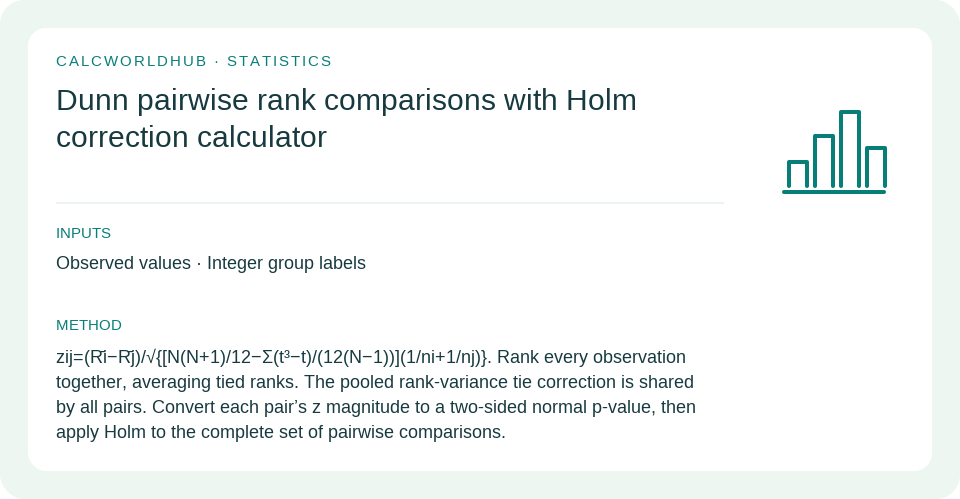
zij=(R̄i−R̄j)/√{[N(N+1)/12−Σ(t³−t)/(12(N−1))](1/ni+1/nj)}.
Rank every observation together, averaging tied ranks. The pooled rank-variance tie correction is shared by all pairs. Convert each pair’s z magnitude to a two-sided normal p-value, then apply Holm to the complete set of pairwise comparisons.
A worked scenario
Observed values = 2,4,5,3,6,7,8,9,11; Integer group labels = 1,1,1,2,2,2,3,3,3.
- Smallest Holm-adjusted Dunn p-value: 0.0512179833
- Pairwise rank comparisons: 1 vs 2: z=-0.745356, adjusted p=0.45605654; 1 vs 3: z=-2.385139, adjusted p=0.05121798; 2 vs 3: z=-1.639783, adjusted p=0.20210051
The example has three groups with three values each. All three possible pairwise comparisons belong to the Holm family, even if only the smallest adjusted p-value is highlighted.
Assumptions and edge cases
Independent groups, 3–15 integer labels, and rank variation. This is an asymptotic pairwise procedure, not an exact test. Distribution-shape differences complicate interpreting results as pure median shifts.
Reading the outputs
Pair labels identify the original groups. Positive z means the first named group has the higher average pooled rank; the adjusted p-value is two-sided.
Frequently asked questions
Is this the same as separate Mann–Whitney tests?
No. Dunn uses ranks pooled across all groups and a common rank variance.
Must the omnibus test be significant first?
That depends on the prespecified analysis plan; the calculator does not impose a gate.
Are ties supported?
Yes. Average ranks and a pooled tie correction are used.
How do I use the Dunn pairwise rank comparisons with Holm correction calculator?
Enter Observed values, Integer group labels. Match the units shown beside each field and review the result together with the assumptions below.
What is a worked example of Dunn pairwise rank comparisons with Holm correction?
Observed values = 2,4,5,3,6,7,8,9,11; Integer group labels = 1,1,1,2,2,2,3,3,3. Smallest Holm-adjusted Dunn p-value: 0.0512179833 Pairwise rank comparisons: 1 vs 2: z=-0.745356, adjusted p=0.45605654; 1 vs 3: z=-2.385139, adjusted p=0.05121798; 2 vs 3: z=-1.639783, adjusted p=0.20210051 The example has three groups with three values each. All three possible pairwise comparisons belong to the Holm family, even if only the smallest adjusted p-value is highlighted.
Method reference: scikit-posthocs Dunn comparisons and tie correction.
Read our calculation methodology.