How to use this calculator
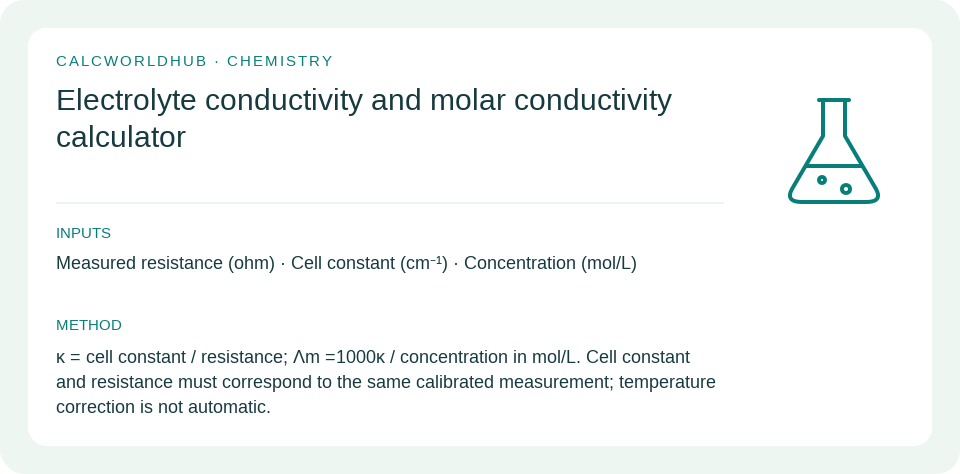
Convert a conductivity-cell resistance to conductivity and molar conductivity.
- Enter Measured resistance (ohm), Cell constant (cm⁻¹), Concentration (mol/L). Match the units shown beside each field and review the result together with the assumptions below.
- Read the worked example below to check the expected input format and result.
- Compare another scenario by changing one input at a time. Use Reset to return to the starting values.
Electrolyte conductivity and molar conductivity explained
Electrolyte conductivity combines measured resistance with a calibrated cell constant. Molar conductivity then divides by solute concentration on a compatible volume basis, so converting mol/L to mol/cm³ contributes an explicit factor of one thousand.
Inputs, symbols, and units
r— Measured resistance (ohm)- Positive calibrated solution resistance in ohms, measured at the stated test condition.
k— Cell constant (cm⁻¹)- Positive cell constant in inverse centimeters, representing electrode geometry from calibration.
c— Concentration (mol/L)- Positive molar concentration in mol/L, matched to the measured solution and temperature.
Formula and method
κ = cell constant / resistance; Λm =1000κ / concentration in mol/L.
Cell constant and resistance must correspond to the same calibrated measurement; temperature correction is not automatic.
A worked scenario
Measured resistance (ohm) = 200; Cell constant (cm⁻¹) = 1; Concentration (mol/L) = 0.01.
- Conductivity: 0.005 S/cm
- Molar conductivity: 500 S·cm²/mol
Conductance is 1/200=0.005 S. Multiplying by the 1 cm⁻¹ cell constant gives 0.005 S/cm; molar conductivity is 1000×0.005/0.01=500 S·cm²/mol.
Assumptions and edge cases
Cell constant and resistance must correspond to the same calibrated measurement; temperature correction is not automatic.
Frequently asked questions
Is conductance conductivity?
Conductance is 1/R; conductivity includes the cell geometry.
Why multiply by 1000 for molar conductivity?
Concentration is supplied in mol/L rather than mol/cm³.
Must temperature be controlled?
Yes, conductivity is temperature dependent.
How do I use the Electrolyte conductivity and molar conductivity calculator?
Enter Measured resistance (ohm), Cell constant (cm⁻¹), Concentration (mol/L). Match the units shown beside each field and review the result together with the assumptions below.
What is a worked example of Electrolyte conductivity and molar conductivity?
Measured resistance (ohm) = 200; Cell constant (cm⁻¹) = 1; Concentration (mol/L) = 0.01. Conductivity: 0.005 S/cm Molar conductivity: 500 S·cm²/mol Conductance is 1/200=0.005 S. Multiplying by the 1 cm⁻¹ cell constant gives 0.005 S/cm; molar conductivity is 1000×0.005/0.01=500 S·cm²/mol.
Read our calculation methodology.