How to use this calculator
Convert an embedded local-error estimate into a bounded next-step proposal for an adaptive integrator.
- Enter Estimated local error norm, Target local error norm, Current step, Error power in step size, then complete the remaining labeled fields. Match the units shown beside each field and review the result together with the assumptions below.
- Read the worked example below to check the expected input format and result.
- Compare another scenario by changing one input at a time. Use Reset to return to the starting values.
Embedded local error step size controller explained
This controller scales the current integration step using the ratio of target tolerance to estimated local error and the assumed error power. A safety factor leaves margin, while a configured clipping interval limits the proposed increase or decrease; it does not decide whether the current step is accepted.
Inputs, symbols, and units
error— Estimated local error norm- Nonnegative norm of the difference-based local error estimate.
tolerance— Target local error norm- Positive tolerance measured in the same norm.
stepSize— Current step- Current positive integration step.
power— Error power in step size- Local error is modeled proportional to h to this power. Enter a whole number.
safety— Safety factor- Multiplier below one to leave room for estimation error.
Formula and method
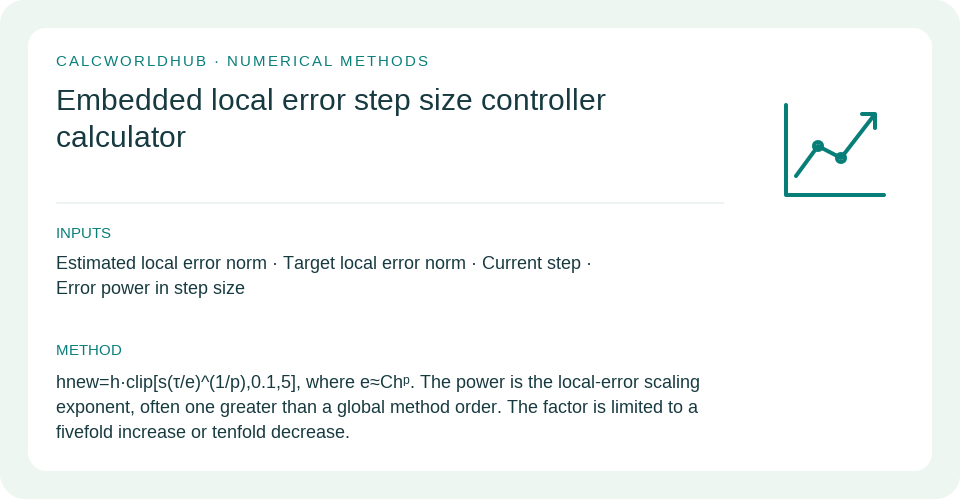
hnew=h·clip[s(τ/e)^(1/p),0.1,5], where e≈Chᵖ.
The power is the local-error scaling exponent, often one greater than a global method order. The factor is limited to a fivefold increase or tenfold decrease.
A worked scenario
Estimated local error norm = 0.004; Target local error norm = 0.001; Current step = 0.1; Error power in step size = 5; Safety factor = 0.9.
- Proposed next step: 0.068207 time units
- Limited step factor: 0.682072
- Normalized current error: 4
A local error of 0.004 against tolerance 0.001 and fifth-power scaling reduces a 0.1 step to about 0.06821 at safety 0.9.
Assumptions and edge cases
This page does not estimate an ODE error itself or decide whether a step should be accepted. A positive nonzero estimate is required.
Reading the outputs
Proposed step uses time units, the factor is dimensionless, and normalized error above one indicates that the current trial exceeded tolerance.
Frequently asked questions
Should I accept the current step when normalized error exceeds one?
Typically it is rejected; this page reports the proposal but does not manage solver state.
Why cap the increase?
A sudden large step can invalidate the local error model.
Which power should I choose?
Use the documented scaling power of your embedded error estimator.
How do I use the Embedded local error step size controller calculator?
Enter Estimated local error norm, Target local error norm, Current step, Error power in step size, then complete the remaining labeled fields. Match the units shown beside each field and review the result together with the assumptions below.
What is a worked example of Embedded local error step size controller?
Estimated local error norm = 0.004; Target local error norm = 0.001; Current step = 0.1; Error power in step size = 5; Safety factor = 0.9. Proposed next step: 0.068207 time units Limited step factor: 0.682072 Normalized current error: 4 A local error of 0.004 against tolerance 0.001 and fifth-power scaling reduces a 0.1 step to about 0.06821 at safety 0.9.
Background or definition reference: NIST DLMF ordinary differential equations.
Read our calculation methodology.