How to use this calculator
Normalize daily milk yield for fat and protein content using a stated energy-corrected milk equation.
- Enter Milk yield (kg/day), Milk fat (%), Milk protein (%). Match the units shown beside each field and review the result together with the assumptions below.
- Read the worked example below to check the expected input format and result.
- Compare another scenario by changing one input at a time. Use Reset to return to the starting values.
How this calculation works
Milk volume alone does not show how much fat and protein a herd produces. Energy-corrected milk (ECM) expresses milk output on a common energy basis using milk mass and component yields. Enter daily milk mass in kilograms and fat and protein percentages for the same sample; the calculator applies one published equation so results can be compared on a consistent basis.
Inputs and units
milkKg— Milk yield (kg/day)- Daily milk mass for a cow or the consistently defined group being evaluated.
fatPct— Milk fat (%)- Fat concentration as a percentage of milk mass.
proteinPct— Milk protein (%)- Protein concentration as a percentage of milk mass.
Formula
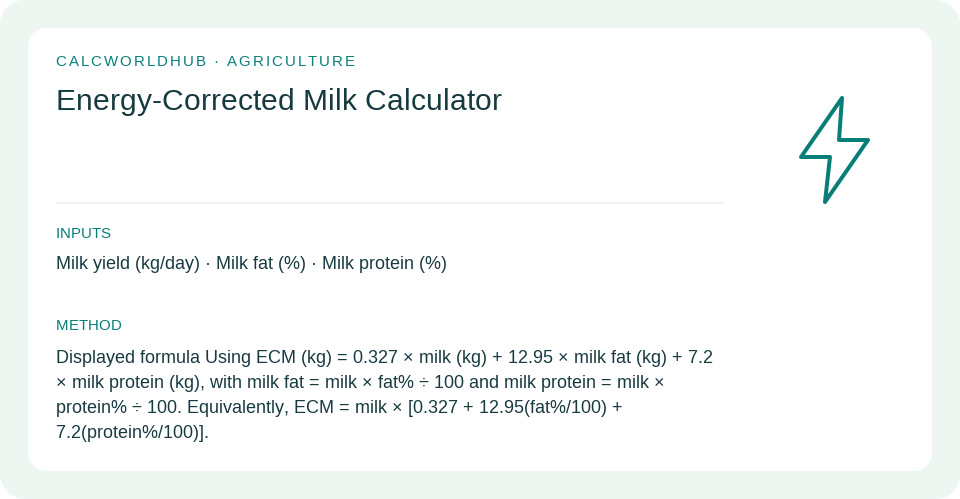
Using ECM (kg) = 0.327 × milk (kg) + 12.95 × milk fat (kg) + 7.2 × milk protein (kg), with milk fat = milk × fat% ÷ 100 and milk protein = milk × protein% ÷ 100. Equivalently, ECM = milk × [0.327 + 12.95(fat%/100) + 7.2(protein%/100)].
Method
The calculator converts the component percentages into fat and protein mass for the entered milk yield, then applies the stated ECM coefficients. The selected equation is reported with the result because published corrected-milk methods can use different coefficient sets.
Worked example
At 30 kg milk/day, 3.8% fat gives 1.14 kg fat and 3.2% protein gives 0.96 kg protein. ECM = 0.327×30 + 12.95×1.14 + 7.2×0.96 = 31.485 kg ECM/day.
Assumptions and limits
This tool uses one published ECM equation and requires milk, fat, and protein values from the same basis and period. It is not a milk-payment calculation or a feed-efficiency ratio; feed efficiency additionally needs dry-matter intake. Do not mix coefficients from different ECM or fat-corrected-milk conventions when comparing herds.
Frequently asked questions
What is energy-corrected milk?
ECM adjusts milk output for energy-bearing components so yields with different fat and protein levels can be compared on the selected equation's basis.
Why do ECM equations use different coefficients?
Corrected-milk methods have been published with different coefficient sets and component bases. This calculator names and applies the stated 0.327/12.95/7.2 equation rather than mixing methods.
Can I use ECM as a feed-efficiency result?
Not by itself. A feed-efficiency ratio also needs dry-matter intake over the matching period; ECM here is only the normalized milk-output measure.
Can I compare kilograms and pounds directly?
No. This page is kg-based. Convert all milk and component masses consistently before applying a formula with coefficients expressed on another unit basis.
How do I use the Energy-Corrected Milk Calculator?
Enter Milk yield (kg/day), Milk fat (%), Milk protein (%). Match the units shown beside each field and review the result together with the assumptions below.
Reference: Peer-reviewed dairy production study stating the Orth energy-corrected milk equation. See our calculation methodology.