Enzyme specific activity calculator
Divide a modeled enzyme rate by molar enzyme concentration.
Calculator
How to use this calculator
Normalize a modeled Michaelis–Menten rate by enzyme concentration in μM; result is rate per concentration.
- Enter Maximum reaction rate Vmax, Substrate concentration [S] (mM), Michaelis constant Km (mM), Enzyme concentration [E] (μM). Match the units shown beside each field and review the result together with the assumptions below.
- Read the worked example below to check the expected input format and result.
- Compare another scenario by changing one input at a time. Use Reset to return to the starting values.
Normalize modeled reaction rate by enzyme concentration
This page divides a Michaelis–Menten rate by the entered molar enzyme concentration. Because the denominator is concentration, the result is rate per concentration rather than conventional activity per mass of protein.
Inputs and units
- Maximum reaction rate Vmax: Use the rate unit you want in the numerator.
- Substrate concentration [S] (mM): Enter substrate concentration.
- Michaelis constant Km (mM): Use the same concentration unit as [S].
- Enzyme concentration [E] (μM): Enter a positive enzyme concentration; it is the divisor in this page’s normalization.
Formula and method
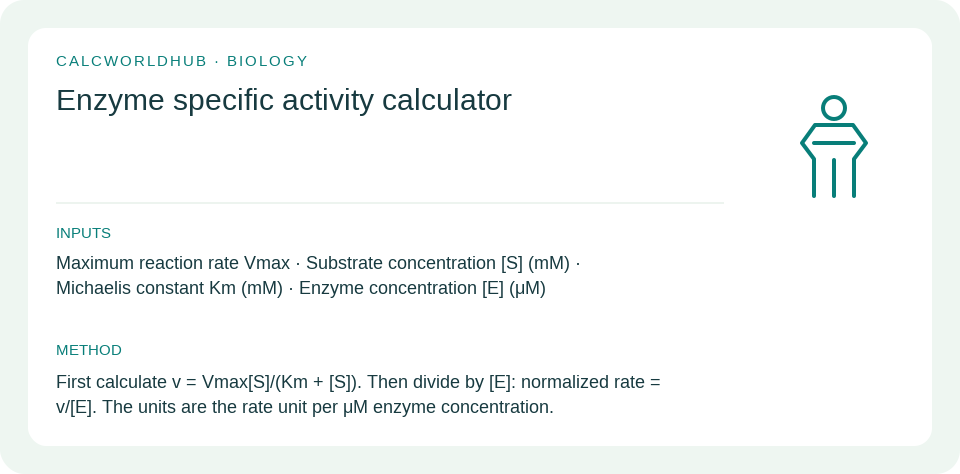
First calculate v = Vmax[S]/(Km + [S]). Then divide by [E]: normalized rate = v/[E]. The units are the rate unit per μM enzyme concentration.
Worked example
With Vmax = 12 units/min, [S] = 3 mM, Km = 2 mM, and [E] = 0.5 μM, v = 7.2 units/min and v/[E] = 14.4 units/min/μM.
Interpreting the result
The output compares modeled rate with enzyme concentration. Do not treat it as the usual assay specific activity in units per milligram unless the denominator is protein mass and the assay defines compatible activity units.
Assumptions and limits
Experimental specific-activity reporting often normalizes measured activity by protein mass. This calculator instead divides a model rate by molar concentration, so use its displayed units and verify the intended quantity before comparing results.
Method references
Frequently asked questions
Is this the usual specific activity in U/mg?
No. The calculator’s input is enzyme concentration in μM, so the result is rate per concentration, not activity per protein mass.
Why are the Michaelis–Menten inputs included?
They determine the modeled rate v before the page divides by enzyme concentration.
How do I use the Enzyme specific activity calculator?
Enter Maximum reaction rate Vmax, Substrate concentration [S] (mM), Michaelis constant Km (mM), Enzyme concentration [E] (μM). Match the units shown beside each field and review the result together with the assumptions below.
What is a worked example of Enzyme specific activity?
With Vmax = 12 units/min, [S] = 3 mM, Km = 2 mM, and [E] = 0.5 μM, v = 7.2 units/min and v/[E] = 14.4 units/min/μM.
What does the Enzyme specific activity calculator calculate?
Normalize a modeled Michaelis–Menten rate by enzyme concentration in μM; result is rate per concentration.
Good calculators show their work.
CalcWorldHub is built around clear inputs and visible assumptions. Results are estimates for planning; check official sources or your provider’s terms when exact figures matter.