EOQ replenishment cycle calculator
Use a basic EOQ frequency to estimate working days between orders.
Calculator
How to use this calculator
Estimate EOQ replenishment-cycle working days from annual demand and inventory costs.
- Enter Annual demand (units), Order cost ($/order), Annual holding cost ($/unit), Working days per year. Match the units shown beside each field and review the result together with the assumptions below.
- Read the worked example below to check the expected input format and result.
- Compare another scenario by changing one input at a time. Use Reset to return to the starting values.
Estimate days between orders from the EOQ model
This page uses the economic order quantity model to estimate orders per year, then converts that frequency into working days per replenishment cycle.
Inputs and units
- Annual demand (units): Expected demand over one year.
- Order cost ($/order): Fixed administrative or setup cost associated with placing an order.
- Annual holding cost ($/unit): Annual cost to hold one unit in inventory.
- Working days per year: Workdays used to convert order frequency into a cycle length.
Formula and method
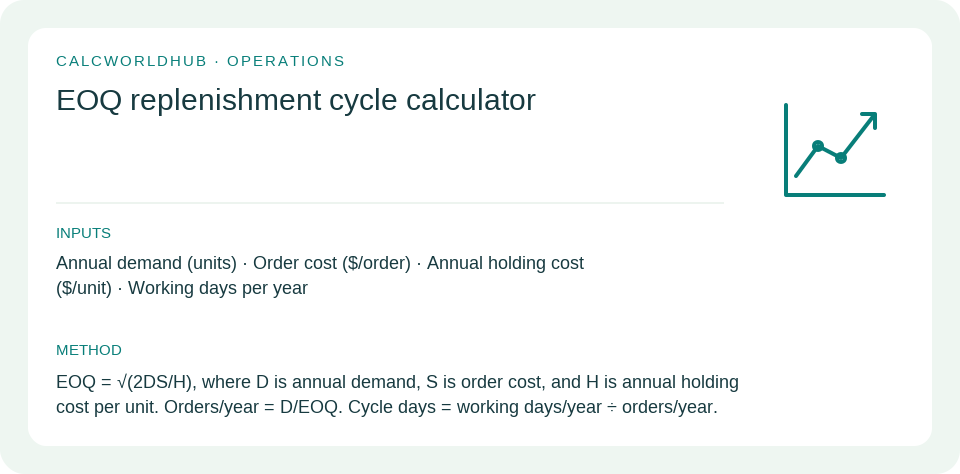
EOQ = √(2DS/H), where D is annual demand, S is order cost, and H is annual holding cost per unit. Orders/year = D/EOQ. Cycle days = working days/year ÷ orders/year.
Worked example
With D = 12,000, S = $35, H = $2.50, and 250 working days, EOQ ≈ 579.66 units and the cycle is about 12.08 working days.
Interpreting the result
The value is a model-based interval under steady annual demand. It is not a recommended reorder point; lead time and safety stock are separate decisions.
Assumptions and limits
The basic EOQ model assumes stable demand and costs, instant replenishment, no quantity discounts, and no capacity constraints. Annual demand and holding cost must use the same year basis.
Frequently asked questions
Is this the number of calendar days between orders?
No. The input is working days per year, so the result is working days.
Does this include supplier lead time?
No. Cycle length describes the modeled gap between orders; lead time affects when to place them.
How do I use the EOQ replenishment cycle calculator?
Enter Annual demand (units), Order cost ($/order), Annual holding cost ($/unit), Working days per year. Match the units shown beside each field and review the result together with the assumptions below.
What is a worked example of EOQ replenishment cycle?
With D = 12,000, S = $35, H = $2.50, and 250 working days, EOQ ≈ 579.66 units and the cycle is about 12.08 working days.
What does the EOQ replenishment cycle calculator calculate?
Estimate EOQ replenishment-cycle working days from annual demand and inventory costs.
Good calculators show their work.
CalcWorldHub is built around clear inputs and visible assumptions. Results are estimates for planning; check official sources or your provider’s terms when exact figures matter.