How to use this calculator
Calculate chemical oxygen demand with the EPA 410.3 high-level saline-water titration equation.
- Enter Ferrous ammonium sulfate for blank, A (mL), Ferrous ammonium sulfate for sample, B (mL), Titrant normality, C (N), Method chloride correction, D, then complete the remaining labeled fields. Match the units shown beside each field and review the result together with the assumptions below.
- Read the worked example below to check the expected input format and result.
- Compare another scenario by changing one input at a time. Use Reset to return to the starting values.
How this calculation works
This worksheet applies the titrimetric equation in EPA Method 410.3. It uses ferrous ammonium sulfate volumes for the reagent blank and sample, titrant normality, the method’s chloride correction from its standard curve, and sample volume. It is specific to that method rather than a general colorimetric COD conversion.
Inputs and units
blank— Ferrous ammonium sulfate for blank, A (mL)- Titrant volume used for the reagent blank.
sample— Ferrous ammonium sulfate for sample, B (mL)- Titrant volume used for the sample.
normality— Titrant normality, C (N)- Normality of the standardized ferrous ammonium sulfate titrant.
chloride— Method chloride correction, D- Use the correction value from the method curve, with the method’s stated units and procedure.
volume— Sample volume (mL)- Aliquot volume used in the calculation.
Formula
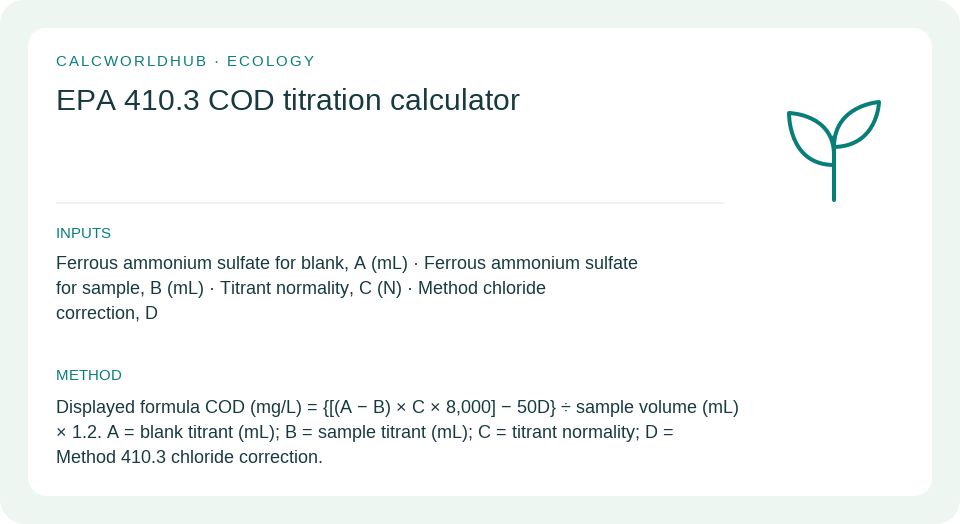
COD (mg/L) = {[(A − B) × C × 8,000] − 50D} ÷ sample volume (mL) × 1.2. A = blank titrant (mL); B = sample titrant (mL); C = titrant normality; D = Method 410.3 chloride correction.
Method
Enter A, B, C, D, and sample volume as defined by EPA Method 410.3. Obtain D from the method’s chloride-correction curve; the 1.2 factor and correction term are part of the stated equation.
Worked example
With A = 15.0 mL, B = 10.0 mL, C = 0.100 N, D = 0, and a 50 mL sample, COD = [(5.0 × 0.100 × 8,000) ÷ 50] × 1.2 = 96 mg/L.
Assumptions and limits
This calculates the arithmetic only. EPA Method 410.3 is a specific titrimetric method for high-level saline waters. It does not replace method selection, digestion, calibration, quality control, safety procedures, or current regulatory requirements. Do not substitute a colorimetric test’s inputs.
Frequently asked questions
Is this the EPA 410.4 colorimetric equation?
No. It is the titrimetric equation from EPA Method 410.3; colorimetric methods use different procedures and inputs.
Where does the chloride correction come from?
Method 410.3 specifies a correction curve. Enter the value obtained under that procedure; the tool cannot derive it from chloride concentration alone.
Can this calculator validate my lab result?
No. It checks arithmetic only and does not perform digestion, calibration, QC review, safety checks, or regulatory method selection.
How do I use the EPA 410.3 COD titration calculator?
Enter Ferrous ammonium sulfate for blank, A (mL), Ferrous ammonium sulfate for sample, B (mL), Titrant normality, C (N), Method chloride correction, D, then complete the remaining labeled fields. Match the units shown beside each field and review the result together with the assumptions below.
What is a worked example of EPA 410.3 COD titration?
With A = 15.0 mL, B = 10.0 mL, C = 0.100 N, D = 0, and a 50 mL sample, COD = [(5.0 × 0.100 × 8,000) ÷ 50] × 1.2 = 96 mg/L.
Reference: technical reference. See our calculation methodology.