How to use this calculator
Euler’s totient φ(n) counts positive integers up to n that are relatively prime to n.
- Enter Positive integer n. Match the units shown beside each field and review the result together with the assumptions below.
- Read the worked example below to check the expected input format and result.
- Compare another scenario by changing one input at a time. Use Reset to return to the starting values.
How Euler totient calculator works
Euler’s totient φ(n) counts positive integers up to n that are relatively prime to n.
Inputs and units
- Positive integer n: n must be a positive whole number from 1 to 10¹².
Formula and method
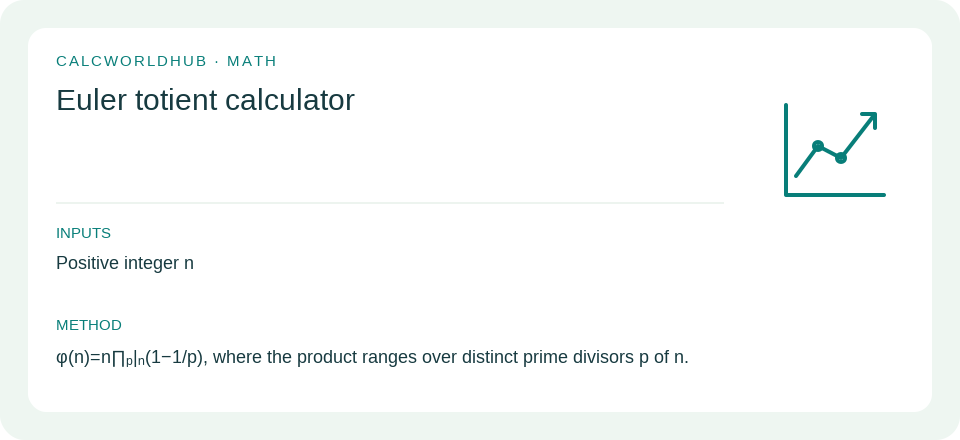
φ(n)=n∏ₚ|ₙ(1−1/p), where the product ranges over distinct prime divisors p of n.
Worked example
For n=36=2²·3², φ(36)=36(1−1/2)(1−1/3)=12.
Interpreting the result
There are 12 integers in {1,…,36} with greatest common divisor 1 with 36.
Assumptions and limits
The input is limited to 10¹² for practical factorization. φ(1)=1 because the single integer 1 is relatively prime to itself.
Frequently asked questions
What does relatively prime mean?
Two integers are relatively prime when their greatest common divisor is 1.
Why does n=1 return one?
The set {1} contains one integer and gcd(1,1)=1.
How do I use the Euler totient calculator?
Enter Positive integer n. Match the units shown beside each field and review the result together with the assumptions below.
What is a worked example of Euler totient?
For n=36=2²·3², φ(36)=36(1−1/2)(1−1/3)=12.
What does the Euler totient calculator calculate?
Euler’s totient φ(n) counts positive integers up to n that are relatively prime to n.