How to use this calculator
Test equality of two independent Poisson event rates by conditioning on their combined event count and known exposures.
- Enter Group one events, Group one exposure, Group two events, Group two exposure. Match the units shown beside each field and review the result together with the assumptions below.
- Read the worked example below to check the expected input format and result.
- Compare another scenario by changing one input at a time. Use Reset to return to the starting values.
Exact conditional comparison of two Poisson rates explained
Test equality of two independent Poisson event rates by conditioning on their combined event count and known exposures.
How the calculation works
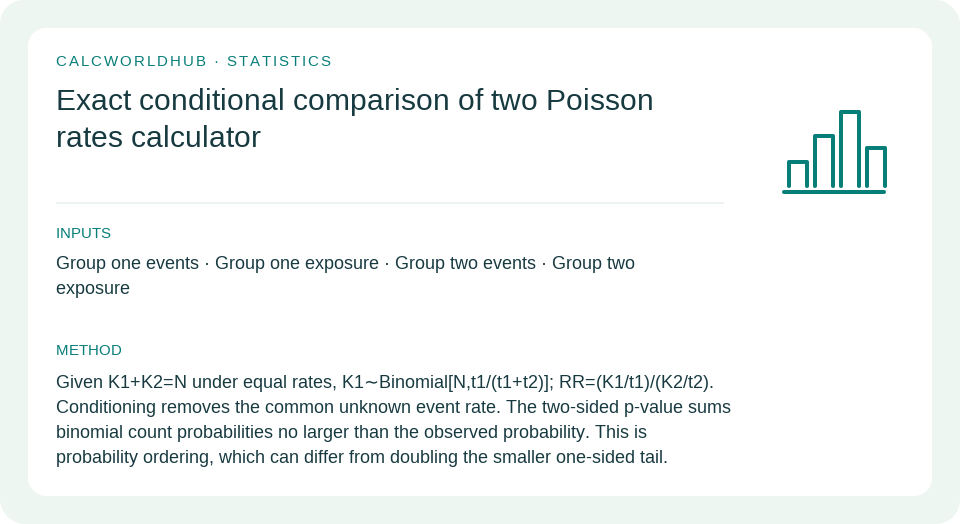
Given K1+K2=N under equal rates, K1∼Binomial[N,t1/(t1+t2)]; RR=(K1/t1)/(K2/t2).
Conditioning removes the common unknown event rate. The two-sided p-value sums binomial count probabilities no larger than the observed probability. This is probability ordering, which can differ from doubling the smaller one-sided tail.
Set up the calculation
k1— Group one events- Nonnegative whole event count for this independent group. Enter a whole number.
t1— Group one exposure- Known positive exposure for this group, in the same exposure unit as the other group.
k2— Group two events- Nonnegative whole event count for this independent group. Enter a whole number.
t2— Group two exposure- Known positive exposure for this group, in the same exposure unit as the other group.
Limits of this model
Independent constant-rate Poisson processes, positive exposures, and 1–20,000 combined events. No rate-ratio confidence interval is supplied. If group two has zero events the sample ratio is infinite, while the conditional test remains defined.
Check this example
Group one events = 8; Group one exposure = 100; Group two events = 18; Group two exposure = 140.
- Exact equal-rate conditional p-value: 0.3217922392
- Observed rate ratio group 1/group 2: 0.62222222
- Group 1 rate: 0.08 events/exposure unit
- Group 2 rate: 0.12857143 events/exposure unit
Eight of twenty-six combined events occur in group one. Under equal rates, its expected share is 100/240 because exposures are unequal, rather than one half.
Reading the outputs
The p-value tests equal rates. The observed rate ratio gives effect direction but has no uncertainty interval on this page.
Frequently asked questions
Can I compare proportions of subjects instead?
Binomial subject outcomes require a proportion test; Poisson exposure counts have a different sampling model.
What if both counts are zero?
There is no conditional event information, so this calculator rejects that case.
Must exposure units match?
Yes. A rate ratio is meaningful only with a common exposure unit.
How do I use the Exact conditional comparison of two Poisson rates calculator?
Enter Group one events, Group one exposure, Group two events, Group two exposure. Match the units shown beside each field and review the result together with the assumptions below.
What is a worked example of Exact conditional comparison of two Poisson rates?
Group one events = 8; Group one exposure = 100; Group two events = 18; Group two exposure = 140. Exact equal-rate conditional p-value: 0.3217922392 Observed rate ratio group 1/group 2: 0.62222222 Group 1 rate: 0.08 events/exposure unit Group 2 rate: 0.12857143 events/exposure unit Eight of twenty-six combined events occur in group one. Under equal rates, its expected share is 100/240 because exposures are unequal, rather than one half.
Method reference: SciPy exact binomial probability-ordering test.
Read our calculation methodology.