How to use this calculator
Convert a continuous first-order plant into exact coefficients for a digital simulation with a held actuator input.
- Enter Continuous DC gain, Continuous lag time (s), Sample interval (s). Match the units shown beside each field and review the result together with the assumptions below.
- Read the worked example below to check the expected input format and result.
- Compare another scenario by changing one input at a time. Use Reset to return to the starting values.
Exact sampled first order held input model explained
Use Continuous DC gain with Continuous lag time (s) to reproduce the sample calculation, then review the stated limits before carrying the result into another scenario.
A numerical walkthrough
Continuous DC gain = 2; Continuous lag time (s) = 0.8; Sample interval (s) = 0.1.
- Discrete state multiplier: 0.882497 ratio
- Discrete input coefficient: 0.235006 output/input
- Samples per time constant: 8 samples
A gain-two lag of 0.8 seconds is sampled every tenth of a second.
The model behind the numbers
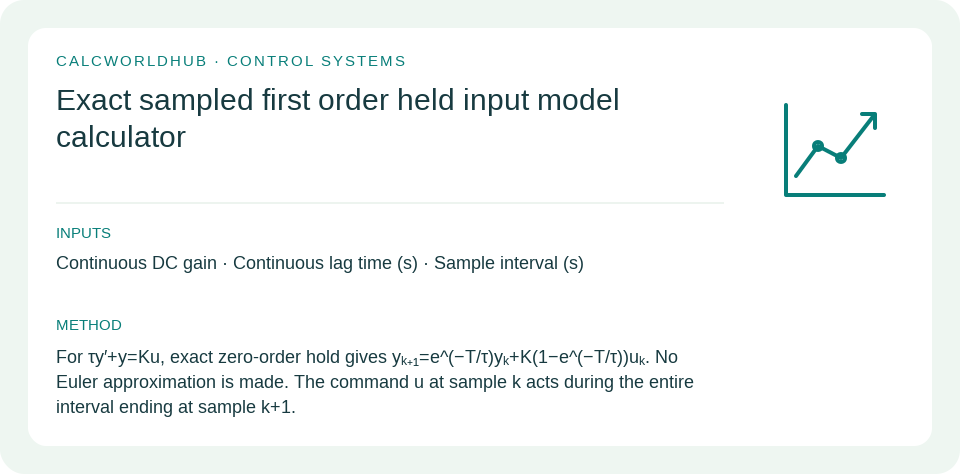
For τy′+y=Ku, exact zero-order hold gives yₖ₊₁=e^(−T/τ)yₖ+K(1−e^(−T/τ))uₖ.
No Euler approximation is made. The command u at sample k acts during the entire interval ending at sample k+1.
What to enter
K— Continuous DC gain- Output/input gain of the continuous lag.
tau— Continuous lag time (s)- Positive time constant.
T— Sample interval (s)- Duration for which each input is held.
Interpreting the result
One lag, no dead time, no input variation within a sample.
Reading the outputs
The multiplier and input coefficient define the complete recurrence; samples per time constant describes temporal resolution.
Frequently asked questions
Is this the same as a moving average?
No; it is a recursive exponential state update.
Can the input gain be negative?
Yes; the discrete input coefficient retains that sign.
Does a long interval make the exact model wrong?
The endpoints remain exact for held input, but intervening motion is unresolved.
How do I use the Exact sampled first order held input model calculator?
Enter Continuous DC gain, Continuous lag time (s), Sample interval (s). Match the units shown beside each field and review the result together with the assumptions below.
What is a worked example of Exact sampled first order held input model?
Continuous DC gain = 2; Continuous lag time (s) = 0.8; Sample interval (s) = 0.1. Discrete state multiplier: 0.882497 ratio Discrete input coefficient: 0.235006 output/input Samples per time constant: 8 samples A gain-two lag of 0.8 seconds is sampled every tenth of a second.
Background or definition reference: SciPy continuous-to-discrete models.
Read our calculation methodology.