Expected failures over a mission calculator
Estimate the mean count of failures during an exposure interval using a constant nonnegative event rate.
How to use this calculator
Estimate the mean count of failures during an exposure interval using a constant nonnegative event rate.
- Enter Failure rate per time unit, Exposure duration. Match the units shown beside each field and review the result together with the assumptions below.
- Read the worked example below to check the expected input format and result.
- Compare another scenario by changing one input at a time. Use Reset to return to the starting values.
How the Expected failures over a mission calculator works
Estimate the mean count of failures during an exposure interval using a constant nonnegative event rate.
Inputs and units
- Failure rate per time unit: Nonnegative event rate per chosen time unit.
- Exposure duration: Nonnegative exposure in the matching time unit.
Formula and method
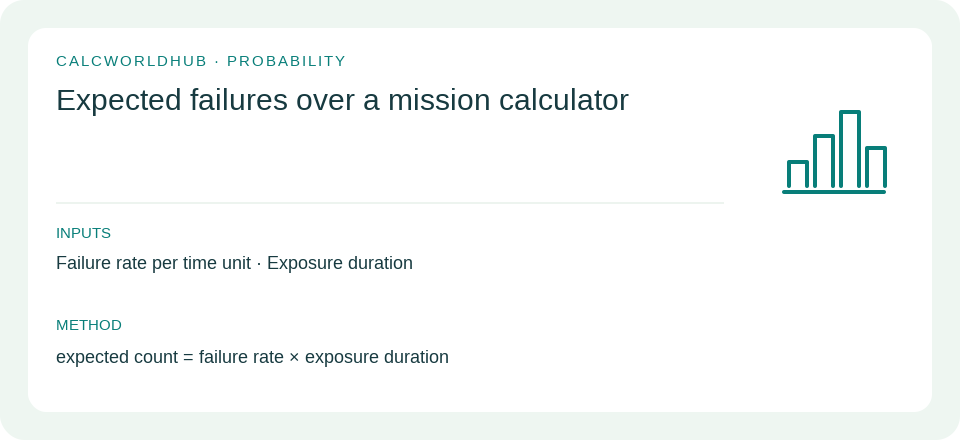
expected count = failure rate × exposure duration
Worked example
A rate of 0.02 failures per time unit over 50 matching units gives an expected count of 1.
Interpreting the result
An expected count of one is an average across comparable exposures, not a guarantee of exactly one event.
Assumptions and limits
Assumes a constant-rate repeatable event process. It is not the probability of at least one failure or the chance an unrepaired single component survives.
Sources and method
- Defines the event-count distribution with mean μ; a constant event rate over exposure gives μ=rate×time. SciPy: Poisson distribution
Frequently asked questions
Is an expected count of one a 100% failure probability?
No. Under a Poisson model, P(at least one)=1−e^−1, about 63.2%.
Can the expectation be fractional?
Yes. Expectations are averages and need not be whole event counts.
How do I use the Expected failures over a mission calculator?
Enter Failure rate per time unit, Exposure duration. Match the units shown beside each field and review the result together with the assumptions below.
What is a worked example of Expected failures over a mission?
A rate of 0.02 failures per time unit over 50 matching units gives an expected count of 1.
What does the Expected failures over a mission calculator calculate?
Estimate the mean count of failures during an exposure interval using a constant nonnegative event rate.
See the calculation methodology.